The Challenge Every Automotive Manufacturer Knows Too Well
You’re sitting on a production floor. A critical vehicle component has failed — or worse, it’s a legacy part with no original drawings, no CAD file, and no surviving supplier. Your options look bleak: expensive tooling recreations, months of delays, or scrapping the project entirely.
This isn’t a rare scenario. It’s a weekly reality for automotive OEMs, Tier-1 suppliers, and fleet operators managing aging platforms, discontinued models, or complex custom assemblies. The traditional engineering pipeline — design, prototype, manufacture — simply doesn’t account for what already exists and what no longer has documentation.
That’s exactly why we built our service offering the way we did.
What “End-to-End” Actually Means — and Why It Matters to You
Most vendors offer one piece of the puzzle. One company scans your part. Another converts the scan to CAD. A third handles machining. Every handoff is a risk: data loss, tolerance drift, miscommunication, and lead time blowout.
We operate differently.
At RM Engineering, we deliver the complete value chain under one roof — right here in Chennai:
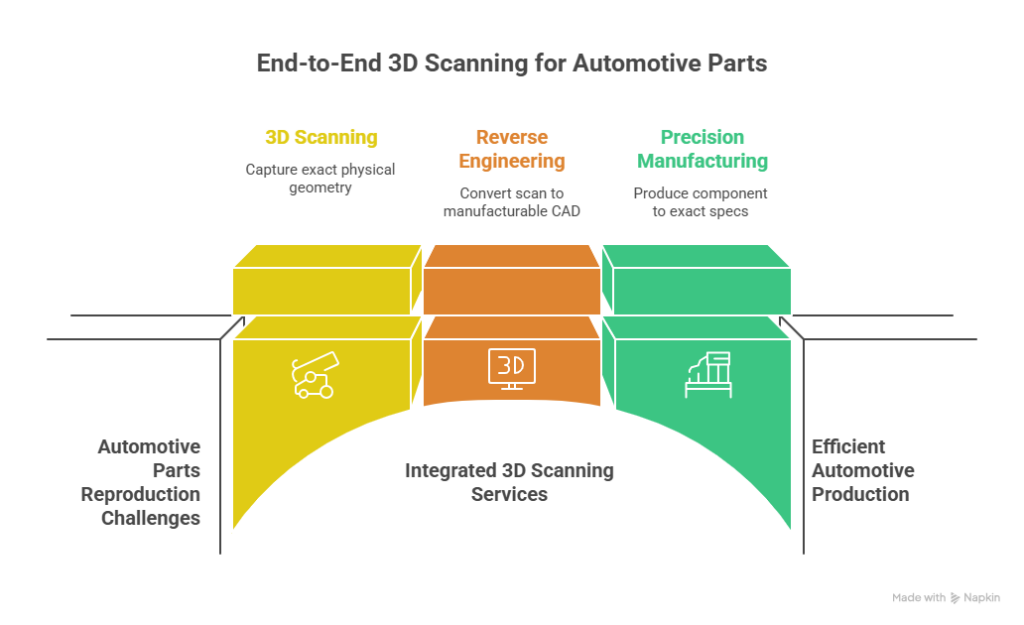
- 3D Scanning → We capture the exact physical geometry of your part
- Reverse Engineering → We convert that scan data into accurate, manufacturable CAD models
- Precision Manufacturing → We produce the final component to your exact specifications
This integrated approach eliminates the three most costly problems in automotive parts reproduction: time waste, tolerance error, and vendor fragmentation.
Stage 1: Our 3D Scanning Services — Where Your Accuracy Journey Begins
Precision starts with capture. Using high-resolution laser scanning technology, we digitize every curve, surface, and dimension of your physical part — whether it’s a chassis bracket, engine housing, or custom body component — and convert it into a precise digital point cloud that perfectly mirrors what you handed us.
Here’s what makes our scanning capability different for automotive clients:
- Non-contact laser scanning ensures zero damage to sensitive, worn, or irreplaceable original parts
- Portable scanners allow us to come to your facility and scan large assemblies or installed vehicle components on-site
- High-resolution capture records complex geometries that traditional CMMs miss entirely
- Seamless CAD integration means our scan output flows directly into our reverse engineering workflow — no data conversion delays
For our automotive clients specifically, we apply 3D scanning across quality control inspections, prototype digitization, damage assessment of collision components, and — most critically for legacy fleets — the reproduction of discontinued parts that have no surviving blueprints.
“3D scanning creates the digital twin of your physical world — and in automotive manufacturing, that digital twin is our gateway to building your next production-ready component.”
Stage 2: Our Reverse Engineering Services — From Scan Data to Manufacturable CAD
Scanning captures what exists. Our reverse engineering work answers how to recreate it — and improve it.
We take your raw 3D scan data and reconstruct it into fully parametric, engineering-grade CAD models. This isn’t just file conversion. Our engineers analyze every detail of the scanned geometry to:
- Reconstruct design intent, not just geometry
- Identify tolerances and fit requirements for assembly compatibility
- Recommend material optimizations or geometry enhancements where we spot an opportunity
- Produce CAD files compatible with downstream CNC machining, casting, or additive manufacturing
This expertise matters enormously in the automotive world. A scanned door hinge isn’t just a shape — it’s a load-bearing assembly component with precise angular tolerances, surface finish requirements, and fatigue considerations. Our team brings the domain-specific automotive engineering knowledge needed to translate scan data into parts that actually perform in the real world — not just look correct on screen.
Automotive reverse engineering projects we regularly handle include:
- Reproduction of legacy ECU housings and sensor brackets
- Recreation of jigs, fixtures, and tooling with no surviving drawings
- Design improvement of existing suspension or drivetrain components
- EV conversion engineering — adapting IC engine platforms to electric drivetrains (one of our documented specialisations)
Stage 3: Our Precision Manufacturing — We Don’t Stop at CAD
This is where most reverse engineering firms hand your project off. We don’t.
Once your CAD model is verified and approved, we manufacture the actual component — whether it’s a one-off prototype for validation or a production batch for your supply chain. We handle complex and precision components using high-quality measuring instruments throughout our entire production process to ensure every part we deliver meets the design specifications we built together.
Why our in-house manufacturing makes a real difference:
- Zero data handoff risk — The same team that reverse engineered your part is the team that manufactures it
- Tighter tolerances maintained end-to-end — Dimensional integrity is preserved from the first scan to the finished component
- Faster turnaround — No external supplier queue, no logistics delay, no waiting on third parties
- Cost efficiency — Single-vendor pricing eliminates multi-party markup from your project budget
For automotive clients working against production deadlines, this isn’t a convenience — it’s a competitive advantage you can measure in weeks saved and costs avoided.
The Business Case: Why Automotive Teams Choose Our Integrated Approach
Let’s be transparent about ROI. When automotive procurement and engineering teams evaluate partners like us, they’re measuring:
| Metric | Multi-Vendor Approach | Our Integrated Approach |
| Lead Time | 6–12 weeks (across vendors) | 2–4 weeks (single workflow) |
| Tolerance Drift Risk | High (each handoff adds error) | Minimal (one team, one standard) |
| Cost Structure | 3x vendor markups | Single-source pricing |
| IP Security | Data shared with 3+ parties | Contained entirely within our facility |
| Accountability | Shared and diffused | 100% single-point responsibility — us |
For quality-sensitive components in braking systems, steering assemblies, or powertrain housings, that accountability and tolerance integrity is non-negotiable. We’ve built our entire service model around owning that responsibility.
Who We Built This Service For
Our combined offering is purpose-built for:
- OEM engineering teams managing platform lifecycle extensions or tooling gaps
- Tier-1 and Tier-2 automotive suppliers reproducing legacy components or tooling
- Classic and vintage vehicle restorers needing precision re-manufacturing of obsolete parts
- EV conversion specialists adapting existing IC platforms to electric drivetrains
- Fleet operators maintaining aging commercial vehicle fleets with discontinued part challenges
- R&D teams needing a reliable physical-to-digital pipeline for competitive benchmarking
If you’re in automotive and you’re facing a scenario where a physical part exists but the documentation doesn’t — this is the service we built for you.
What to Expect When You Work With Us
We believe transparency builds trust before a single component is scanned. Here’s exactly how your project flows when you engage us:
Step 1: Consultation & Scope Definition You share the part, the application context, and your quantity and timeline requirements. Our team evaluates feasibility and defines the optimal scanning approach for your specific component.
Step 2/: 3D Scanning We conduct on-site or in-lab scanning of your original component. A complete, validated digital point cloud is generated and reviewed for completeness before we proceed.
Step 3: Reverse Engineering & CAD Development We process the scan into a parametric CAD model. Our engineering review ensures design intent, tolerances, and material specifications are accurately captured and documented.
Step 4: Your Design Approval We share the CAD model with you for review and sign-off. We don’t move to manufacturing until you’re satisfied with what we’ve built.
Step 5: Precision Manufacturing We produce your component using the appropriate manufacturing method — CNC machining, casting, or additive manufacturing — with in-process dimensional inspection at every critical stage.
Step 6: Quality Verification & Delivery We dimensionally verify every final part against the approved CAD model and deliver with full inspection reports, so you have complete confidence in what you receive.
Why Work With Us?
We’re based in Chennai — India’s automotive manufacturing capital — which means we understand the production pressures, supply chain realities, and quality standards our clients operate under every single day. Our work spans IC engine to EV conversion projects, complex precision component manufacturing, and quality inspection services for automotive manufacturers across the region.
Our differentiator isn’t just the technology we operate. It’s our commitment to owning your entire engineering journey from the first laser scan to the final delivered component sitting in your hands.
We don’t hand your project off. We see it through.
Ready to Solve Your Parts Challenge?
If your team is dealing with legacy components, discontinued parts, or complex precision manufacturing requirements, the answer isn’t coordinating three different vendors — it’s one partner who does it all.
Talk to our engineering team today → Tell us about your component, your timeline, and your production goals. We’ll come back to you with a consultation and a clear project pathway.
Frequently Asked Questions
Q1: Can you reproduce a part if we have no original CAD drawings or technical documentation?
Absolutely — this is precisely the scenario our 3D scanning and reverse engineering service is designed for. By physically scanning your existing component, we create accurate, manufacturing-ready CAD data from scratch. You don’t need to bring us a single drawing.
Q2: What types of automotive parts can you reverse engineer and manufacture?
We handle a wide range of components including structural brackets, housing assemblies, engine components, suspension parts, jigs, tooling, sensor mounts, EV conversion adapters, and complex precision components. If it can be physically scanned, we can reverse engineer and manufacture it.
Q3: How accurate is your 3D scanning for automotive-grade components?
Our high-resolution laser scanning technology captures dimensional data with precision sufficient for automotive-grade tolerance requirements. We validate scan accuracy before the reverse engineering phase begins, ensuring downstream manufacturing meets your specifications — not just close to them.
Q4: Do you handle both prototype quantities and production batch manufacturing?
Yes. We support both single-unit prototyping for design validation and batch production for supply chain fulfilment. We discuss scope and quantity upfront during our initial consultation so you get a realistic timeline and cost from day one.
Q5: How long does your complete scan-to-manufactured-part process take?
Timeline depends on part complexity, quantity, and manufacturing method. For most precision automotive components, our integrated workflow runs significantly faster than coordinating multiple vendors — typically within 2 to 4 weeks for standard complexity parts.
Q6: How do you protect our component design data and intellectual property?
We handle all client data — scan files, CAD models, and design specifications — under strict professional confidentiality. All work is conducted entirely within our facility, which means your design data never passes through external vendor systems.
Q7: What’s the difference between 3D scanning and reverse engineering? Don’t I need both?
Yes — and here’s why. 3D scanning captures the physical geometry of your part as a digital point cloud. Reverse engineering takes that data and reconstructs it into a fully parametric, engineering-grade CAD model — complete with design intent, tolerances, and manufacturing specifications. One without the other doesn’t produce a manufacturable outcome. We do both, which is why our workflow is complete.
Q8: Do you support EV conversion engineering projects?
Yes. We have hands-on experience in IC engine to EV conversion projects, which involves scanning existing IC platform components, reverse engineering them, and manufacturing the adapted parts needed to accommodate electric drivetrain integration. This is one of our active specialisations.
Q9: Where are you located and do you offer on-site scanning?
We’re based in Chennai, India — the heart of India’s automotive manufacturing ecosystem. We offer both in-house lab scanning and portable on-site scanning for large assemblies or installed vehicle components that can’t be transported to our facility.
Q10: How do we get started?
The simplest first step is to visit rmtes.com and send us your project details. Our engineering team will get back to you with a consultation to understand your requirements and lay out the right service pathway for your component challenge.