Choosing the Wrong Vendor Costs More Than the Job Itself
Reverse engineering is not a commodity service. The quality of the output depends entirely on the experience, equipment, and engineering judgment of the team doing the work.
A poor reverse engineering job does not announce itself immediately. It shows up later: when the manufactured part does not fit, when the tolerances are off, when the CAD file cannot be used by your machinist, or when you receive a digital model that looks right on screen but produces a wrong component on the shop floor.
By that point, you have lost time, money, and in some cases, the original part itself.
This guide is for Chennai manufacturers who are evaluating reverse engineering service providers and want to know what to check before committing to a vendor.
What Reverse Engineering Actually Involves
Before evaluating vendors, it helps to understand what a proper reverse engineering engagement looks like from start to finish.
A complete reverse engineering job has four distinct stages:
Scanning. The physical part is captured using a 3D scanner. The output is a point cloud: a dense set of data points representing the exact surface geometry of the object.
CAD reconstruction. An engineer works from the point cloud to build a parametric CAD model. This is not automated. It requires engineering judgment to interpret design intent, reconstruct clean geometry, and produce a model that reflects how the part was designed to work — not just how it looks after years of wear.
Inspection and verification. The CAD model is compared back against the original scan to confirm accuracy. Deviations beyond acceptable tolerances are corrected before the drawing is finalised.
Manufacturing or delivery. The finished deliverable is either a set of engineering drawings and a CAD file, or the actual manufactured component, depending on what the client needs.
A vendor who skips or compresses any of these stages is cutting corners that will cost you later.
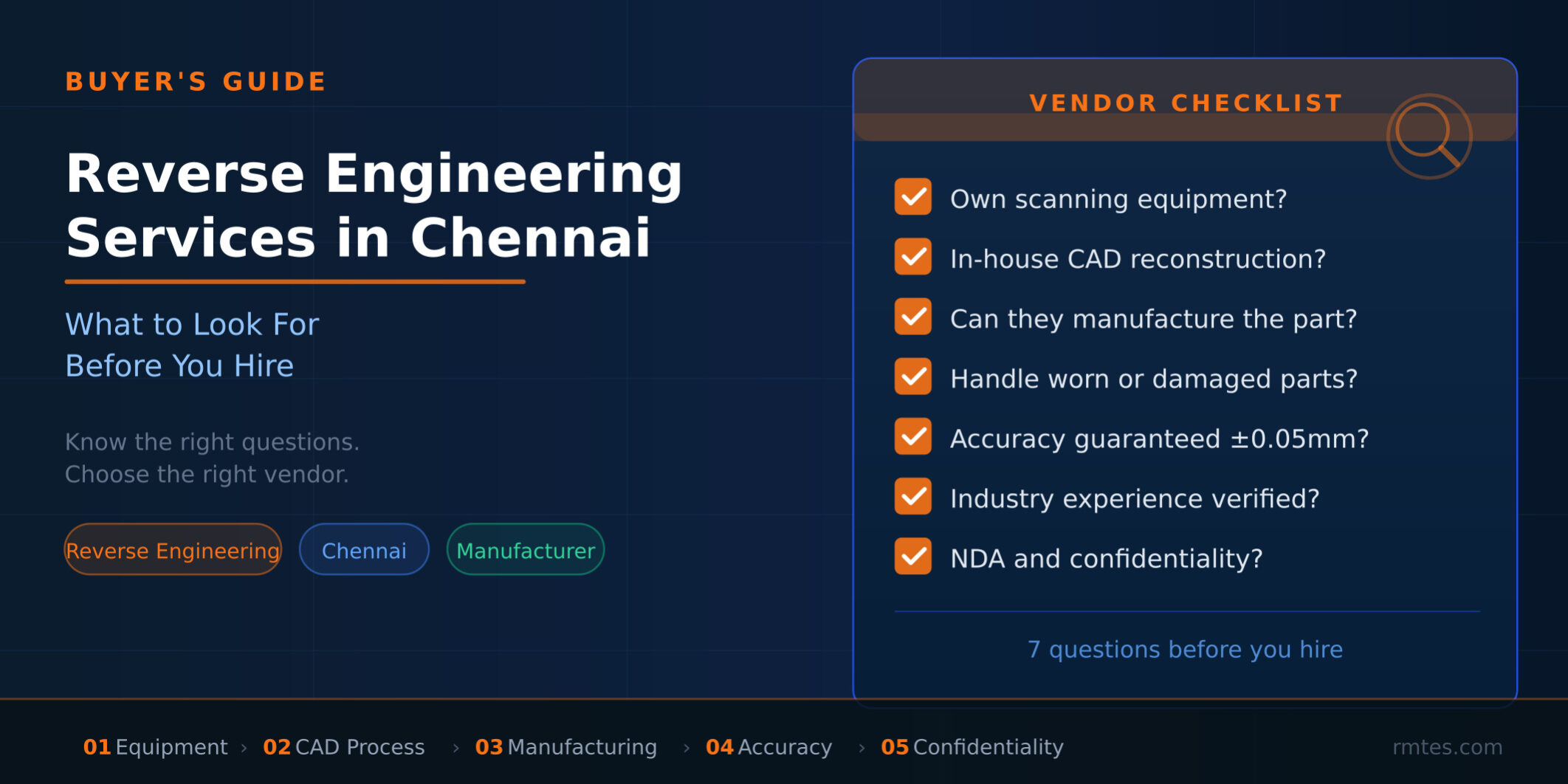
7 Things to Check Before You Hire a Reverse Engineering Company in Chennai
1. Do they own their scanning equipment, or do they outsource it?
This is the first question to ask. Many companies in Chennai market reverse engineering services but do not own a 3D scanner. They subcontract the scanning to another vendor, mark it up, and pass the file to you.
This creates two problems. First, you are paying a premium for coordination, not expertise. Second, there is no accountability when the scan quality is poor — each vendor points at the other.
Ask directly: what scanner do you use, and is it in your facility? A professional operation will answer this without hesitation and will be willing to show you the equipment.
2. What is their CAD reconstruction process?
Scanning is the easier part. CAD reconstruction is where most vendors fall short.
A point cloud is raw data. Converting it into a clean, manufacturable CAD model requires engineers who understand mechanical design: how features relate to each other, what tolerances matter for function, and how to handle the wear and imperfections present in a used or damaged part.
Ask to see examples of their CAD output. Ask whether the reconstruction is done in-house or sent to a third party. Ask what software they use and whether the output format is compatible with your machinist or design team.
A vendor who cannot walk you through their reconstruction process in plain terms is unlikely to produce a file you can rely on.
3. Can they manufacture the part, or do they stop at the file?
This is the question that separates full-service providers from scan-only operations.
Receiving a CAD file is not the end of the job. You still need a machinist who can interpret the drawing, select the right material, machine to the correct tolerances, and deliver a part that fits and functions correctly.
When scanning and manufacturing are handled by different companies, things go wrong in the handoff. Tolerances get misinterpreted. Features that were captured in the scan but not clearly communicated in the drawing get dropped. The manufactured part does not match the scanned geometry.
A provider who handles both reverse engineering and manufacturing under one roof eliminates this risk. There is one team, one set of drawings, and one point of accountability.
Before you hire, ask: do you manufacture the final part, or do you only deliver the CAD file?
4. How do they handle worn or damaged parts?
Most parts that come in for reverse engineering are not in perfect condition. They are worn, corroded, partially broken, or dimensionally distorted after years of use.
An inexperienced team will scan the part as-is and reproduce the worn geometry faithfully — including every scratch, every dimension that has drifted out of spec, every surface that has been ground down by contact.
An experienced team will identify what the part was designed to be, not just what it has become. They will reconstruct the original design intent: a bore that should be perfectly round at 25.00mm, not the 24.87mm oval it has worn into.
Ask the vendor: how do you handle wear and damage in the parts you scan? The answer tells you whether they are applying engineering judgment or just running software.
5. What accuracy can they guarantee?
Professional 3D scanning equipment captures geometry to tolerances of ±0.05mm or better. Ask any vendor you are evaluating what the accuracy specification of their scanner is, and ask for it in writing if the part is precision-critical.
Also ask about their inspection process. How do they verify that the CAD model matches the scanned geometry? Do they produce a colour deviation map or a dimensional inspection report? For critical components, this verification step is non-negotiable.
A vendor who cannot specify their accuracy or does not have an inspection step is not suitable for precision manufacturing applications.
6. Do they have experience in your industry?
Reverse engineering a decorative consumer product is not the same as reverse engineering a pump impeller, a gear set, a mould tool, or a precision jig. Each industry has its own material requirements, tolerance expectations, surface finish standards, and functional considerations.
Ask whether the vendor has experience with parts similar to yours. Ask to see case studies or client references from your industry segment. A vendor who has worked extensively with Chennai’s automotive cluster understands what tier-1 and tier-2 suppliers need. A vendor who has handled defence and research components understands precision and confidentiality requirements.
Industry familiarity is not just about technical capability. It is about knowing what questions to ask before the job starts.
7. How do they handle confidentiality?
Your part geometry is your intellectual property. A reverse-engineered CAD model of a proprietary component contains sensitive information about your product, your tooling, and your manufacturing process.
Ask the vendor directly: what is your data confidentiality policy? Do you retain scan data after the job is complete? Are you willing to sign an NDA?
Any professional reverse engineering company will have a clear answer to these questions. If a vendor is vague about how they handle client data, treat it as a serious red flag.
A Checklist Before You Sign Off
Use this before committing to any reverse engineering vendor in Chennai:
| Question | What to look for |
|---|---|
| Do you own your scanning equipment? | Yes, in-house |
| What scanner do you use and what is the accuracy? | Named equipment, ±0.05mm or better |
| Is CAD reconstruction done in-house? | Yes, by qualified engineers |
| Can you manufacture the finished part? | Yes, with in-house machining |
| How do you handle worn or damaged parts? | Design intent reconstruction, not just raw scan output |
| Do you produce an inspection report? | Yes, deviation analysis before delivery |
| Do you have industry experience relevant to my part? | Verified case studies or references |
| Will you sign an NDA? | Yes, without hesitation |
If a vendor cannot answer yes to all of these, keep looking.
What RM Engineering Technologies Offers
RM Engineering Technologies is a Chennai-based provider of 3D scanning, reverse engineering, 3D inspection, and CNC manufacturing services, operating from a single facility in Ekkatuthangal.
Against the checklist above:
We own and operate our scanning equipment in-house. CAD reconstruction is done by our engineering team, not outsourced. We manufacture finished components in our own CNC facility — we do not stop at the file. We handle worn, broken, and damaged parts routinely, applying engineering judgment to reconstruct original design intent. We produce dimensional inspection reports for every precision job. We have verified experience across automotive, pump manufacturing, defence, and research sectors in Chennai. We sign NDAs and maintain strict data confidentiality for all client work.
We have done this for clients including NIOT (National Institute of Ocean Technology), Chennai — a project involving a precision transducer mould with complex geometry and no existing drawings.
“This company has an excellent team of CAD engineers and experienced machinists, both conventional and CNC. They helped us make a precise mould for our transducer.” — M. Sankar, Scientist-G, NIOT Chennai
How to Start an Evaluation
If you are currently evaluating reverse engineering providers in Chennai, the fastest way to assess a vendor is to give them a real part.
Bring or send us your component. We will assess it the same day, walk you through our approach, show you our facility and equipment, and give you a clear timeline and cost estimate. There is no charge for this assessment.
WhatsApp a photo of your part to +91 98408 62525. We will respond within 2 hours.
Or visit us directly:
RM Engineering Technologies No. 20, Gandhi Nagar Main Road, Ekkatuthangal, Chennai – 600 032
Email: in**@***es.com
Summary
Reverse engineering is a high-skill service. The difference between a good vendor and a poor one is not visible in a brochure — it shows up in the quality of the CAD output and the accuracy of the finished part.
Before you hire, check that your vendor owns their equipment, reconstructs CAD in-house, can manufacture the final part, handles worn components with engineering judgment, verifies accuracy before delivery, has relevant industry experience, and takes confidentiality seriously.
RM Engineering Technologies meets every one of these criteria, from a single facility in Chennai.