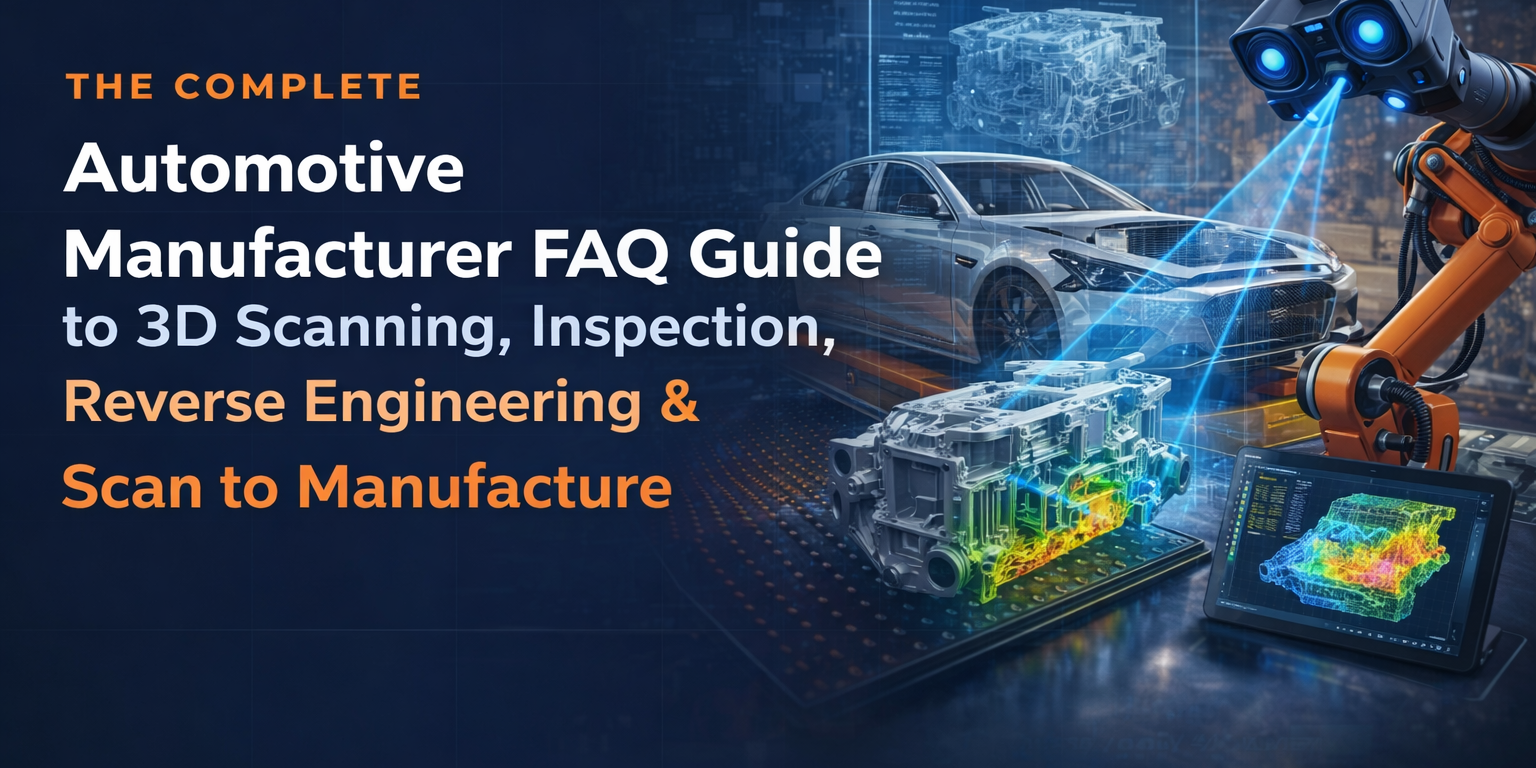
If you manufacture automotive parts or components — whether you are an OEM supplier, a Tier-1 or Tier-2 producer, a stamping shop, an injection molder, or a custom machining facility — chances are you’ve encountered questions about 3D scanning, dimensional inspection, reverse engineering, or how to go from a physical reference part to a production-ready CAD model.
This comprehensive FAQ resource is built specifically for the automotive manufacturing industry, covering everything from foundational concepts to advanced applications. Where relevant, we explain how RM Engineering Technologies can help you solve these challenges.
Q1. What is 3D scanning and how does it work for automotive parts?
3D scanning is a non-contact measurement technology that captures the precise geometry of a physical object — like an automotive part, jig, fixture, or entire vehicle body — using laser or structured light and converts it into a highly accurate digital 3D model (point cloud or mesh).
The scanner emits a laser beam or light pattern onto the object’s surface, measures the reflection, and records millions of data points per second. The collected data is processed using specialized software into a file compatible with CAD, inspection, or manufacturing tools.
In automotive manufacturing, this translates to faster quality checks, zero-contact measurement, and data that drives smarter engineering decisions.
Q2. What types of 3D scanning technologies are available for automotive applications?
The three primary 3D scanning technologies used in automotive manufacturing are:
- Laser Triangulation Scanning: Best for medium to large components (body panels, doors, bumpers); captures organic surfaces with high detail.
- Structured Light Scanning: Projects light patterns on the part and uses cameras to detect deformation; delivers excellent accuracy on complex shapes.
- Photogrammetry: Uses multiple photographs to reconstruct 3D geometry; ideal for large assemblies or whole vehicles.
Each technology has strengths depending on part size, surface finish, and required accuracy level.
Q3. How accurate is 3D scanning for automotive-grade precision requirements?
Modern industrial 3D scanners achieve accuracies as tight as ±0.020 mm to ±0.050 mm — well within the tolerances demanded by automotive OEMs and Tier-1 suppliers.
This level of precision allows manufacturers to confidently use scan data for reverse engineering, inspection reporting, and First Article Inspection (FAI), replacing slower and more limited traditional methods like calipers or CMMs for complex surfaces.
RM Engineering Insight: RM Engineering’s scanning equipment meets automotive-grade metrology standards, ensuring your parts are measured to the precision your production line demands.
Q4. What is the difference between 3D scanning and CMM (Coordinate Measuring Machine) measurement?
CMMs use a physical touch probe to measure discrete points on a surface — ideal for simple geometric features like holes, planes, and flat faces.
3D scanning, by contrast, captures millions of points across the entire surface simultaneously — including complex contours, organic shapes, and free-form surfaces — that are physically impossible or impractical for a touch probe. 3D scanning is faster, doesn’t require rigid fixturing, and provides full-field data rather than sampled data.
Many manufacturers use both: CMM for critical machined features and 3D scanning for complex surfaces, in a complementary hybrid approach.
Q5. Can 3D scanning handle reflective, dark, or shiny automotive surfaces like chrome or painted body panels?
Reflective, dark, and shiny surfaces are among the most common challenges in automotive 3D scanning. High-gloss paint, chrome trim, and polished metal can scatter or absorb laser light, creating gaps in the point cloud.
Solutions include:
- Applying a temporary scanning spray (white or matte coating) that washes off without damaging the surface.
- Using blue-light structured light scanners which are less sensitive to surface reflectivity.
- Adjusting scanner exposure settings and using cross-polarization filters.
The right technique depends on the material and application.
Q6. How long does it take to 3D scan an automotive part?
Scan time varies by part complexity and size:
- Small precision components (bracket, connector, sensor housing): 15–45 minutes including data processing.
- Large body panels or vehicle sub-frames: 1–4 hours.
- Complete vehicle body: A full day or more.
Modern handheld scanners dramatically reduce setup time compared to older systems — what used to take days of manual measurement can be completed in hours.
Q7. What is 3D inspection and why is it critical for automotive manufacturing?
3D inspection compares the actual as-built dimensions of a manufactured part against its intended as-designed CAD model.
In automotive manufacturing, where every millimeter matters for safety, fit, function, and regulatory compliance, 3D inspection is not optional — it’s essential. It detects warpage, tooling deterioration, shrinkage, surface deviations, and other defects before parts reach the assembly line, preventing costly downstream failures, recalls, and rework.
RM Engineering Insight: RM Engineering provides comprehensive 3D inspection services in Chennai, generating detailed deviation color maps and dimensional reports that help automotive manufacturers catch defects early and optimize production.
Q8. What is a color map deviation report in 3D inspection?
A color map deviation report is a visual output generated by 3D inspection software that overlays your scanned part onto the original CAD model and color-codes every surface point based on its deviation from the design specification.
Green typically means the part is within tolerance; red and blue indicate areas that are out of tolerance (over/under). This makes it instantly clear — even to non-engineers — where a part is deviating and by how much.
Q9. What types of defects can 3D inspection detect in automotive parts?
3D inspection can detect a wide range of defects across materials and part types, including:
- Dimensional deviations: Parts outside design tolerances.
- Warpage and distortion: Common in injection-molded plastics and stamped sheet metal.
- Surface defects: Dents, sink marks, and incomplete fills.
- Tooling wear: Progressive deviation from nominal as the tool degrades over production runs.
- Weld distortion and assembly misalignment.
- GD&T violations: Flatness, roundness, true position, and parallelism errors.
Q10. What is First Article Inspection (FAI) and how does 3D scanning support it?
First Article Inspection (FAI) is the formal process of verifying that a newly manufactured part from a new tool, process, or supplier meets all drawing and specification requirements before production begins.
Traditionally, FAI was a slow, point-by-point manual measurement exercise. With 3D scanning, engineers capture full-surface scan data of the first-off part, compare it to the CAD model, and generate a comprehensive FAI report — covering hundreds of dimensions simultaneously — in a fraction of the time.
Q11. Can 3D inspection be done on the production floor, or does the part need to go to a lab?
Modern portable 3D scanners are designed for on-site, in-process inspection directly on the production floor or even inside the vehicle body. There is no need to transport the part to a metrology lab.
This is especially valuable for large assemblies (body-in-white, chassis frames, engine blocks) that are difficult to move. RM Engineering offers mobile on-site 3D scanning services, bringing precision inspection directly to your facility.
Q12. How is 3D inspection different for stamped sheet metal parts versus injection-molded plastic parts?
- Stamped sheet metal parts tend to deviate due to springback after forming — the metal slightly rebounds from the die shape. 3D inspection reveals exactly where and how much springback has occurred, enabling tooling corrections.
- Injection-molded plastic parts face different challenges: warpage, sink marks, and weld lines caused by differential cooling.
For both, 3D inspection provides the full-surface data needed to understand and correct the root cause.
Q13. How does 3D inspection help with body-in-white (BIW) quality control?
Body-in-white (BIW) inspection is one of the most demanding quality challenges. A car body assembly involves hundreds of components joined by welding, adhesives, and mechanical fasteners.
3D scanning allows manufacturers to check surface continuity, panel gaps and flushness, hole positions, weld seam quality, and structural alignment across the entire body shell — quickly identifying root causes of fit-and-finish problems.
Q14. What is reverse engineering in the context of automotive manufacturing?
Reverse engineering is the process of digitally reconstructing an existing physical part into a fully parametric, editable CAD model — without access to the original design drawings or files.
The process goes: physical part → 3D scan → point cloud/mesh → CAD model → ready for manufacturing or modification.
Q15. When do automotive manufacturers typically need reverse engineering?
The most common triggers include:
- Discontinued or legacy parts with no surviving drawings.
- Worn or broken tooling (dies, jigs, fixtures) that must be reproduced.
- Competitor benchmarking — studying design and manufacturing methods.
- Aftermarket part development — creating upgraded parts that fit OEM specifications.
- Retrofitting older vehicles with new components.
RM Engineering Insight: RM Engineering has successfully reverse engineered complex automotive components — from stamping dies to interior trim — for manufacturers across Chennai and India’s automotive sector.
Q16. What is the step-by-step reverse engineering process using 3D scanning?
- Part Assessment: Understanding the part’s function and design intent.
- 3D Scanning: Capturing precise geometry using laser or structured light.
- Point Cloud Processing: Cleaning and merging scan data into a complete mesh.
- CAD Reconstruction: Converting the mesh into a fully parametric solid model (e.g., in SOLIDWORKS).
- Design Validation: Comparing the CAD model back against the original scan.
- Manufacturing-Ready Output: Delivering STEP, IGES, or native CAD files.
Q17. Can reverse engineering be done on worn or damaged automotive parts?
Yes — and this is one of the most valuable use cases. When a part is worn, the 3D scan captures its current state.
The engineer then uses design intent knowledge and symmetry analysis to reconstruct what the part should look like in its nominal, undamaged condition. This is critical for restoring worn-out dies and molds to their original geometry.
Q18. How do you ensure the reverse-engineered CAD model is accurate enough for production?
Accuracy is validated through a compare-back analysis. The completed CAD model is imported back into the inspection software and compared point-by-point against the original scan.
A color deviation map shows any discrepancy. For production-grade work, deviations should be well within drawing tolerances — typically ±0.05 mm or better for precision components.
Q19. What CAD file formats can be delivered after reverse engineering?
- STEP (.stp): Universal, parametric solid model interchange format.
- IGES (.igs): Surface model format for legacy systems.
- STL (.stl): Mesh format for 3D printing.
- Native formats: SOLIDWORKS (.sldprt), CATIA, NX, Pro/E upon request.
Q20. Is reverse engineering legal for automotive parts?
Reverse engineering for spare parts, aftermarket replacements, or internal benchmarking is generally legal in most jurisdictions, including India, as long as it does not infringe on active patents or registered designs.
However, it is always advisable to consult with a legal professional for your specific use case. RM Engineering recommends legal due diligence before initiating projects for third-party OEM parts.
Q21. What does ‘scan to manufacture’ mean in automotive production?
‘Scan to manufacture’ refers to the end-to-end workflow where a physical part is 3D scanned, converted into a production-ready CAD model, and then used to drive CNC machining, 3D printing, or injection molding.
This workflow dramatically shortens the path from ‘physical reference’ to ‘production ready,’ making it invaluable for legacy part reproduction.
Q22. How do you ensure a manufactured part matches the original scanned reference part?
Matching is validated through a closed-loop inspection workflow: after the part is manufactured, it is 3D scanned again and compared against the original reference scan or the CAD model.
This loop — scan → model → manufacture → re-scan → inspect — ensures any deviation introduced during manufacturing is caught and corrected.
Q23. What types of automotive parts can be reproduced through the scan-to-manufacture process?
- Sheet metal stampings: Body panels, brackets, reinforcements.
- Plastic parts: Trim, housings, covers, ducts.
- Cast components: Engine blocks, gearbox housings.
- Machined parts: Shafts, flanges, bearing seats.
- Tooling: Stamping dies, welding jigs, assembly fixtures.
Q24. Can 3D scanning be used to replicate discontinued or obsolete automotive parts?
Yes. When OEM spare parts become unavailable, 3D scanning allows manufacturers to digitally preserve the geometry of the last known good part.
From that scan, a CAD model is generated and used to produce replacement parts through CNC machining or additive manufacturing. This is vital for classic vehicle restoration and commercial fleet operators.
Q25. How does scan-to-manufacture reduce production lead times?
Traditional development requires manual measurement and multiple prototype iterations. Scan-to-manufacture compresses this by:
- Eliminating manual measurement errors.
- Producing a precise CAD model in days rather than weeks.
- Enabling rapid prototyping (3D printing) to verify fit before committing to hard tooling.
- Reducing costly redesign cycles.
Q26. What is the difference between a mesh model and a parametric CAD model?
- Mesh model (STL/OBJ): A collection of triangular faces; useful for 3D printing but cannot be easily edited.
- Parametric CAD model (STEP, SOLIDWORKS): A structured, editable solid model built with engineering features like extrusions and holes.
For production manufacturing, you need a parametric CAD model, not just a mesh.
Q27. What should automotive manufacturers look for in a 3D scanning partner?
When evaluating partners, assess:
- Equipment quality: Industrial-grade metrology scanners.
- Accuracy specifications: Can they meet your GD&T requirements?
- Domain experience: Do they understand OEM/Tier-1 requirements?
- Full-service capability: Can they go from scan to CAD delivery?
- On-site capability: For scanning large assemblies at your facility.
Q28. Do I need to bring my parts to your facility, or can you come to our manufacturing plant?
Both options are available. Small components can be sent to our Chennai lab, while large assemblies or production tooling are scanned on-site at your facility to eliminate transportation risks.
Q29. How much does 3D scanning and reverse engineering cost?
Costs vary based on part complexity, size, and the type of deliverable. The ROI is usually high; the cost is a fraction of the expense caused by production downtime or tooling failure. Contact RM Engineering for a tailored quote.
Q30. What industries does RM Engineering serve beyond automotive?
- Two-wheeler and commercial vehicle components.
- Aerospace metrology.
- Industrial machinery and heavy equipment.
- Defense and military hardware.
- Medical device validation.
Q31. What is the turnaround time from scanning to final CAD delivery?
- Simple scan/inspection: 1–2 business days.
- Moderate reverse engineering: 3–7 business days.
- Complex tooling/assemblies: 1–3 weeks.
Q32. Can 3D scanning detect internal defects or hidden cracks?
Standard laser scanning captures external surface geometry only. For internal defects like voids or porosity in castings, Computed Tomography (CT) scanning is required.
Q33. How do I know if my scanned data is accurate enough to trust for production?
Scan data accuracy is validated through:
- Scanner calibration certificates.
- Artifact verification scans (certified reference objects).
- Alignment strategies matching your drawing GD&T datum structure.
Q34. What is GD&T analysis and can 3D scanning handle it?
Geometric Dimensioning and Tolerancing (GD&T) defines shape, orientation, and location relative to datums. Modern inspection software measures flatness, true position, parallelism, and more directly from scan data, mirroring your drawing requirements.
Q35. Can 3D scanning data be used for CFD or FEA simulation?
Yes. 3D scan data provides accurate as-built geometry for Computational Fluid Dynamics (CFD) and Finite Element Analysis (FEA). This is often more accurate for simulation than using an “ideal” CAD model.
Q36. How does 3D scanning support supplier quality management?
It enables incoming inspection of supplier parts against your approved CAD. This creates an objective, documented quality record and provides irrefutable evidence in case of dimensional non-conformance.
Q37. What is digital twinning and how does 3D scanning contribute?
A digital twin is a virtual replica of a physical object. 3D scanning creates these twins by capturing the exact as-built geometry, tracking wear over time, and archiving the state of tooling for predictive maintenance.
Q38. Can 3D scanning be integrated into an automated production line?
Yes. Automated 3D inspection systems can be robotic-mounted to scan every part on a high-volume line, alerting the system if a defective part is detected.
Q39. What happens to scan data after the project?
RM Engineering provides clients with complete project data files for their own archives. This data serves as “digital insurance” for future comparisons or tooling repairs.
Q40. We are a small manufacturer — is 3D scanning worth it for us?
Absolutely. You don’t need to own the equipment. Engaging a service provider like RM Engineering allows you to meet OEM quality audits and solve tooling problems without heavy capital expenditure.
Q41. How does RM Engineering Technologies handle a project from inquiry to delivery?
- Consultation: Discussing your challenge.
- Scope Definition: Defining approach and accuracy needs.
- Scanning: On-site or in-lab.
- Engineering: Data processing and CAD construction.
- Quality Review: Internal validation.
- Delivery: Files and findings delivered to your team.
Ready to Bring Precision 3D Scanning to Your Automotive Production?
RM Engineering Technologies | Chennai, India
📞 +91 98408 62525 | ✉ in**@***es.com | 🌐 www.rmtes.com