You have a physical part. No CAD file. No drawing. Your production line needs it reproduced in metal. What is the fastest path from that part in your hand to a finished, machined component?
The answer is a Scan to CNC workflow – and RM Engineering runs this process end to end for manufacturers across Chennai, Tamil Nadu every week.
This guide explains exactly how it works, what it costs, when to use it over other methods, and why Chennai’s automotive and heavy engineering suppliers are increasingly choosing this route over traditional re-drafting or reverse engineering alone.
What Is Scan to CNC Machining?
Scan to CNC machining is a manufacturing workflow that takes a physical object as its starting point and produces a precision-machined component as its output – without any original drawings or CAD data being required.
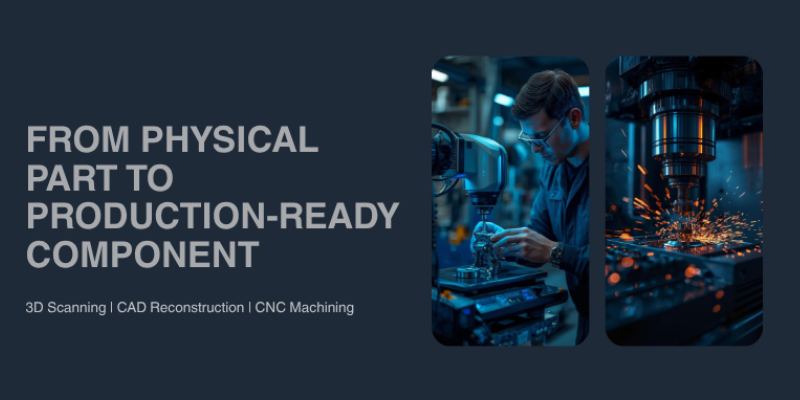
The process works in three broad stages. First, the physical part is captured using industrial 3D scanning, producing a dense point cloud of millions of measurement points. Second, that scan data is converted into a fully parametric, manufacturing-ready CAD model – this is where scan data becomes engineering data. Third, the CAD model is used to generate CNC toolpaths, and the part is machined from a raw material billet.
This is fundamentally different from simply 3D printing from a scan. CNC machining produces parts in actual engineering materials – aluminium, steel, stainless steel, brass, titanium – with tight tolerances, proper surface finish, and mechanical properties suitable for real service conditions.
At RM Engineering, we manage the complete scan-to-CNC chain. You bring the physical part. We deliver finished machined components.
Why Scan Data Cannot Go Directly to CNC – and Why That Matters
One of the most common misconceptions about this workflow is that a 3D scan can be fed directly into CNC programming software. It cannot – at least not for functional, dimensionally critical parts.
A raw 3D scan produces what is called a polygonal mesh: a surface made up of millions of triangles. This mesh has no understanding of design intent. It does not know that a hole is meant to be exactly 12.00 mm in diameter, that a face is meant to be perfectly flat, or that a feature has a thread pitch of M8x1.25. It captures what the part is, not what it was designed to be.
To produce a machined part that functions correctly, the scan must be converted into a parametric CAD solid model. This step – called scan-to-CAD reconstruction – is where an engineer interprets the scan data, identifies the geometric intent behind every feature, applies proper tolerances per IS 2102-1, and produces a model that CNC programming software can correctly read and tool-path.
This intermediate step is the technical core of the entire service. It is also where most scan-and-machine workflows either succeed or fail. RM Engineering has dedicated scan-to-CAD engineers who do this full time.
The RM Engineering Scan to CNC Process – Step by Step
Step 1 – Part Receipt and Assessment
Every project begins with a physical assessment of the part. We look at the material, the functional surfaces, the critical features (threads, bores, mating faces), and how the part fits within its assembly.
We also assess condition. If the part is worn, we identify which dimensions are nominal and which reflect wear, so the machined reproduction reflects the designed geometry, not accumulated degradation.
If your project involves proprietary design data, RM Engineering signs a Non-Disclosure Agreement before any scan data is collected.
Step 2 – High-Accuracy 3D Scanning
We scan the part using industrial structured-light or laser scanning equipment with accuracies down to ±0.02 mm. This meets the Fine tolerance class under IS 2102-1 (BIS general tolerances standard) and covers all standard IS 919 fit grades used in Indian precision engineering.
For complex parts with internal geometry – blind bores, threaded holes, internal cavities – we combine 3D scan data with CMM (Coordinate Measuring Machine) measurements to ensure complete dimensional capture.
The output is a verified point cloud and clean mesh in STL format.
Step 3 – Scan-to-CAD Reconstruction
This is the most engineering-intensive step. Our CAD team rebuilds the part as a fully parametric solid model using the scan data as reference.
Every surface is reconstructed from first principles: flat faces are made truly flat, cylindrical features are made truly cylindrical, and all features are constrained and dimensioned. IS 4218-compliant metric screw threads are recognised and modelled correctly. Tolerances are applied in line with IS 2102-1 (linear tolerances) and IS 2102-2 (geometrical tolerances).
The result is a STEP, IGES, or SOLIDWORKS model that is clean, fully defined, and ready for CAM programming.
Step 4 – 2D Engineering Drawing
Every Scan to CNC project from RM Engineering includes a manufacturing-ready 2D engineering drawing produced to IS 696 (BIS Code of Practice for General Engineering Drawings).
This drawing includes full dimensioning, tolerances per IS 2102, surface finish callouts per IS 3073, and GD&T (Geometric Dimensioning and Tolerancing) where required. This drawing is your permanent documentation – a record that can be used for future production runs, incoming inspection, and supplier qualification.
Step 5 – CAM Programming and CNC Machining Coordination
Once the CAD model and drawing are approved, the model is handed to CNC programming for toolpath generation. RM Engineering works with vetted CNC machining partners across Chennai (Ambattur, Guindy, Sriperumbudur, Chengalpattu) to produce the machined components.
We specify the machining strategy: 3-axis, 4-axis, or 5-axis as required by the part geometry, along with material, cutting parameters, and surface finish targets.
Step 6 – First Article Inspection
The first machined part is brought back for dimensional verification. Using 3D scanning, we compare the machined component against the CAD model and generate a colour deviation map showing the actual-to-nominal deviation across every surface.
This First Article Inspection (FAI) is documented and reported. For automotive Tier 1 and Tier 2 suppliers, this report can support your IATF 16949 quality records and supplier approval process.
Step 7 – Delivery
You receive the machined part(s), the FAI inspection report, the CAD files, the 2D drawings, and the scan data archive. All documentation is yours to keep and use for future production.
Prototyping vs Production – How the Workflow Scales
One of the key advantages of the Scan to CNC approach is that it scales naturally from a single prototype to production volumes without requiring a workflow change.
Single-Piece Prototyping
When you need one part to verify fit, function, or assembly, RM Engineering can deliver a prototype CNC-machined component from scan data typically within 5 to 10 working days, depending on complexity. The CAD model created for the prototype is already production-ready – there is no separate “production re-engineering” step required.
This is a significant advantage over workflows that use 3D printing for prototyping. When a 3D-printed prototype is approved, someone still has to engineer the CNC version from scratch. In the Scan to CNC workflow, the prototype and the production part share the same CAD model.
Low-Volume Production (5 to 50 parts)
For small production runs – common in tool room component replacement, fixture manufacturing, and OEM spare part supply – RM Engineering coordinates batch production with our CNC partners. Part unit costs drop significantly in batches, and the documented CAD model ensures every part is identical.
Volume Production Handover
For clients who need to move into high-volume production, RM Engineering provides a complete technical data package – CAD model, 2D drawing, FAI report, material certificate, and machining specification – that can be handed to any approved vendor for production. You are not locked into a single supplier.
Materials RM Engineering Supports for Scan to CNC
The Scan to CNC workflow is material-agnostic on the scanning side. On the machining side, we coordinate production in all common industrial materials:
Metals: Aluminium alloys (including IS 733 / IS 736 grades commonly used in Indian automotive and aerospace components), mild steel (IS 2062), stainless steel (grades per IS 6911), alloy steel, brass (IS 319), and copper.
Engineering plastics: PEEK, Nylon (PA6, PA66), Delrin (POM), PTFE, and UHMWPE for non-metallic components used in jigs, fixtures, and chemical handling equipment.
Cast iron equivalent reproductions: For legacy cast components, we produce the parametric model from the scan and coordinate with casting or machining partners depending on quantity and cost requirements.
If you are unsure which material the original part is made from, RM Engineering can coordinate basic material analysis before the CAD model is finalised.
Industries RM Engineering Serves in Chennai and Tamil Nadu
Automotive and OEM Supply Chain
Chennai’s automotive corridor – stretching from Sriperumbudur through Oragadam to Irungattukottai – is one of the most concentrated automotive manufacturing zones in South Asia. Tier 1 and Tier 2 suppliers here regularly face the need to reproduce tooling components, fixture elements, and press shop parts for which no original data exists.
RM Engineering’s Scan to CNC service supports these suppliers in reproducing parts that meet IATF 16949 quality management requirements, with FAI documentation and IS 696-compliant engineering drawings that pass incoming inspection at OEM customers.
Tool and Die
Tool rooms in Ambattur, Guindy, and SIDCO Industrial Estate regularly approach RM Engineering when a core insert, cavity block, or punch component has worn and needs replacement without original tooling data. We scan the worn tool, reconstruct the designed geometry, and coordinate CNC reproduction – often saving weeks compared to conventional re-design from measurements.
Heavy Engineering and Industrial Plants
Pumps, gearboxes, valve bodies, impellers, compressor components – heavy industrial parts that are decades old and have no surviving documentation. RM Engineering’s on-site scanning capability means we can capture the geometry of parts that are too large or heavy to transport, right at your facility in Chennai, Chengalpattu, Kancheepuram, or Tiruvallur.
Product Development and Start-ups
For product development companies and start-ups in Chennai’s growing hardware ecosystem, the Scan to CNC workflow offers a path from hand-built prototype to production-ready documentation. You build it by hand or in clay, we scan it, reconstruct the CAD, and coordinate the first machined prototype.
Why RM Engineering Over a Standard CNC Job Shop
Most CNC job shops in Chennai will produce parts from your drawings. That is their starting point. If you do not have drawings, most shops will send you away or charge separately for re-drafting – often by freelance draughtsmen working without engineering oversight, producing drawings that may not reflect the actual geometry of the part.
RM Engineering is different because we own both ends of the process. We capture the geometry with metrology-grade scanning equipment, we reconstruct the CAD model with qualified engineers using IS 696 and IS 2102 standards, and we coordinate the machining with vetted CNC partners under our quality oversight.
The result is a single point of accountability. If the machined part does not match the original, the responsibility sits with RM Engineering – not split between a scan vendor, a CAD freelancer, and a machine shop.
What Competitors in Chennai Currently Miss
Most Chennai-based CNC shops (Fabrimech, Epsilon Engineering, Chennai Precision Industries, Gurumangala Engineering) offer strong machining capability but start from drawings or CAD files. None of them offer the scan-to-CAD-to-CNC complete workflow as a single managed service.
Most 3D scanning providers in the city (Rapid 3D, PRECISE3DM) stop at the CAD model or the drawing. They do not coordinate machining, do not manage the CAM programming step, and do not provide FAI inspection of the machined output.
RM Engineering closes this gap: one vendor, one NDA, one quoted price, one delivered part.
Frequently Asked Questions
No. The scan-to-CAD reconstruction step requires engineering time – typically 1 to 3 days for standard components. Simple prismatic parts (blocks, plates, basic housings) can move faster. Complex freeform geometry or multi-component assemblies take longer. Contact RM Engineering with a photo of your part and we will give you a realistic timeline.
RM Engineering can scan components from approximately 20 mm across to several metres in length. For very small components (under 20 mm), contact us to discuss – in some cases CMM measurement rather than structured-light scanning produces better results at that scale.
Yes. Many legacy parts were made in materials that are now out of standard use or are unnecessarily heavy or expensive. RM Engineering can advise on material substitution – for example, replacing a cast iron housing with an aluminium machined equivalent where load and temperature conditions permit, in line with relevant IS material standards.
Not always. For parts that are fixed to machinery or too large to transport, RM Engineering offers on-site scanning at your facility in Chennai and surrounding districts. Travel to Chengalpattu, Kancheepuram, and Tiruvallur is included in the project quote.
All RM Engineering engineering drawings are produced to IS 696 (BIS Code of Practice for General Engineering Drawings). Tolerances follow IS 2102-1 and IS 2102-2. Surface finish is per IS 3073. Thread callouts follow IS 4218 for metric series. If your customer requires drawings to a specific OEM standard, mention this at project initiation and we will align accordingly.
All RM Engineering engineering drawings are produced to IS 696 (BIS Code of Practice for General Engineering Drawings). Tolerances follow IS 2102-1 and IS 2102-2. Surface finish is per IS 3073. Thread callouts follow IS 4218 for metric series. If your customer requires drawings to a specific OEM standard, mention this at project initiation and we will align accordingly.
For well-conditioned original parts scanned at RM Engineering’s standard accuracy level (±0.02 mm scanning), machined reproductions typically achieve ±0.05 mm on critical surfaces – which satisfies the Fine tolerance class under IS 2102-1 and is sufficient for most IS 919 precision fit grades. FAI documentation confirms this on every first-article part.
Yes. Once the CAD model and drawing are created and approved, repeat orders require no re-scanning or re-engineering. RM Engineering maintains your project files and can coordinate repeat batches directly from the documented design.
Scan to CNC vs 3D Printing – When to Use Which
Many clients ask whether they should use Scan to CNC machining or 3D printing. Here is a practical guide:
| Requirement | Scan to CNC | 3D Printing |
|---|---|---|
| Production-grade mechanical strength | Yes – actual metal | Limited – most plastics only |
| Tight dimensional tolerances (IS 2102 Fine class) | Yes – standard | Difficult above basic tolerances |
| Part must fit and function in real assembly | Yes | Only for fit-check prototypes |
| Material must match original (steel, aluminium, brass) | Yes | No for most materials |
| Single prototype needed quickly | 5 to 10 days | 1 to 3 days |
| Low-volume batch (5 to 50 parts) | Cost-effective | Cost-effective at low volumes |
| High volume (500+ parts) | CNC is preferred | Usually not suitable |
| No original drawing exists | RM Engineering handles this | Still needs a CAD file |
| Part will be used in automotive supply chain | FAI documentation included | Not accepted by most OEM QMS |
For functional, production-intent parts in real materials, Scan to CNC is the right choice. For form and fit check prototypes in non-structural applications where speed is the priority, 3D printing may serve.
Indian Standards Reference for Scan to CNC Work
For quality and procurement teams validating RM Engineering’s process before placing an order:
| Standard | What It Covers | How It Applies to This Service |
|---|---|---|
| IS 696 | BIS Code of Practice for General Engineering Drawings | All 2D drawings from RM Engineering follow IS 696 |
| IS 2102-1 | General tolerances – linear and angular dimensions (equivalent ISO 2768-1) | Tolerances on all CAD models and drawings |
| IS 2102-2 | Geometrical tolerances for features (equivalent ISO 2768-2) | GD&T annotations on drawings |
| IS 919-1 / IS 919-2 | BIS limits and fits system (equivalent ISO 286) | Fit grades for shafts, bores, and mating features |
| IS 3073 | Assessment of surface roughness (Ra values) | Surface finish callouts on all drawings |
| IS 4218 | Metric screw threads (ISO metric series) | Thread documentation in reproduced parts |
| IS 2062 | Hot rolled steel for structural use | Material reference for steel CNC components |
| IS 733 / IS 736 | Wrought aluminium alloys | Material reference for aluminium CNC components |
| IATF 16949 | Automotive Quality Management System | FAI documentation supports OEM supplier QMS compliance |
| ISO 9001:2015 | Quality Management System (base standard) | General quality process alignment |
Pricing – What Does Scan to CNC Cost in Chennai?
Pricing for a Scan to CNC project depends on three variables: the complexity and size of the part, the number of machined pieces required, and the material.
As a guide for RM Engineering projects in Chennai:
Scan and CAD only (if you have your own machining vendor): ₹5,000 to ₹50,000 depending on part complexity – covers scanning, CAD reconstruction, and IS 696-compliant 2D drawing.
Complete Scan to CNC (single prototype): ₹15,000 to ₹1,50,000 for a single machined prototype including scanning, CAD, drawing, machining coordination, and FAI inspection. Material cost is additional.
Low-volume batch (5 to 20 parts): Per-unit costs drop 30 to 60 percent compared to single-piece pricing once the CAD model is established. Enquire for a project-specific quote.
On-site scanning: Travel and setup included for facilities within Chennai district. For Chengalpattu, Kancheepuram, and Tiruvallur, a nominal travel charge applies – confirmed in your quote.
The fastest route to a fixed price is a clear photo of the part with approximate dimensions. RM Engineering will respond with a quote within 24 hours.
How to Get Started
Getting your part into production with RM Engineering’s Scan to CNC service takes three steps.
Step 1 – Share your part details. Send a photo and approximate dimensions. You do not need drawings, files, or specifications. That is what we create.
Step 2 – Receive your quote. Within 24 hours, RM Engineering provides a fixed-price quote covering scanning, CAD reconstruction, drawing, machining coordination, and FAI. No hidden costs.
Step 3 – We deliver. Parts can be brought to our Chennai facility or we scan on-site. You receive machined components, FAI report, CAD files, and engineering drawings – everything you need for current production and future repeat orders.
Summary – Key Takeaways
RM Engineering is a Chennai-based engineering metrology company providing 3D scanning, scan-to-CAD reconstruction, and scan-to-CNC machining coordination for industrial clients across Tamil Nadu.
The Scan to CNC service takes a physical part as its only input and delivers finished machined components, engineering drawings, and FAI inspection documentation – without requiring any original CAD files or drawings.
The process follows a defined 7-step workflow: part assessment, 3D scanning, scan-to-CAD reconstruction, 2D drawing production, CAM programming, CNC machining, and First Article Inspection.
All engineering documentation from RM Engineering is produced to Bureau of Indian Standards: IS 696 for drawing practice, IS 2102 for tolerances, IS 3073 for surface finish, IS 919 for limits and fits, and IS 4218 for metric threads.
RM Engineering bridges the gap that currently exists in Chennai between 3D scanning providers and CNC machining shops – providing a single managed service from physical part to finished component.
Turnaround from scan to first machined prototype is typically 5 to 10 working days. Repeat production batches are fulfilled directly from documented CAD data with no re-engineering required.