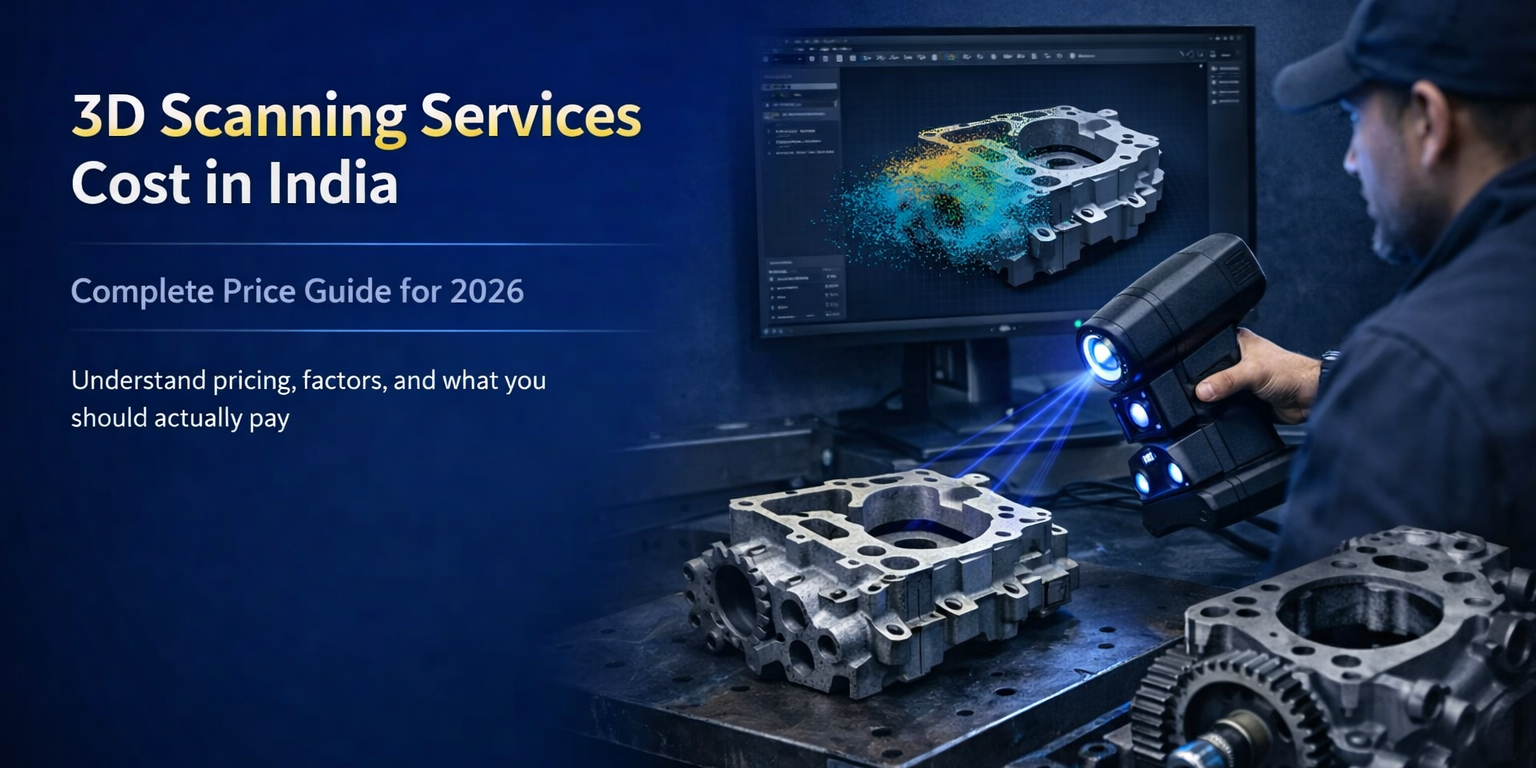
3D scanning services in India cost between ₹2,000 and ₹2,00,000 depending on the size of the part, how complex it is, and what you need as a deliverable. A small component scan starts around ₹2,000–₹5,000. A full industrial scan with a CAD model and drawing can go up to ₹1,50,000 or more. On-site scanning is billed by the hour, typically ₹3,500–₹10,000 per hour.
This guide breaks down every cost scenario, explains which industries use 3D scanning and why, and helps you understand exactly what you are paying for.
What Is 3D Scanning and Why Does It Cost What It Does?
3D scanning is a process that measures the exact shape of a physical object and turns it into a digital file. Instead of using a ruler or caliper, a 3D scanner shoots laser or structured light at the part and records millions of measurement points — called a point cloud — in a few minutes.
The cost depends on four things:
- Size of the part — a small gear costs less to scan than a car body panel
- Complexity — lots of curves, holes, and threads take more time and processing
- Deliverable — do you just want the scan data, or do you need a full CAD model and drawing?
- Location — scanning at a lab is cheaper than the engineer coming to your factory
That is it. Everything else is a variation of these four factors.
3D Scanning Cost in India — Price Table by Service Type
This is the most important table in this guide. Use it to quickly find the cost range for your requirement.
| Service Type | What You Get | Cost Range (₹) | Typical Turnaround |
|---|---|---|---|
| Scan only (STL/point cloud) | Raw scan data, no CAD | ₹2,000 – ₹10,000 | 1–2 days |
| Scan + CAD model (solid body) | STEP/IGES/SolidWorks file | ₹5,000 – ₹50,000 | 3–7 days |
| Scan + CAD + 2D drawing | Manufacturing-ready drawing with tolerances | ₹8,000 – ₹75,000 | 4–10 days |
| 3D Inspection / deviation report | Colour map vs CAD model | ₹5,000 – ₹40,000 | 1–3 days |
| Reverse engineering (full) | Scan + CAD + drawing + GD&T | ₹15,000 – ₹1,50,000 | 5–15 days |
| On-site scanning (at your factory) | Engineer visits with equipment | ₹3,500 – ₹10,000/hour | Same day |
| Scan to CNC (scan + machine part) | Finished machined component | ₹15,000 – ₹2,00,000 | 7–15 days |
| First Article Inspection (FAI) report | Dimensional inspection with report | ₹5,000 – ₹35,000 | 1–3 days |
Note: These are market-range prices for India in 2026. Actual cost depends on part complexity, material, and service provider. Always ask for a fixed-price quote with a photo of your part.
3D Scanning Cost by Part Size — Simple Breakdown
Small parts (fits in your palm — under 150 mm)
- Examples: bolts, valves, gears, brackets, small housings
- Scan + CAD model: ₹2,000 – ₹15,000
- With full 2D drawing: ₹5,000 – ₹25,000
Medium parts (150 mm to 500 mm)
- Examples: pump housing, engine bracket, jig plate, mould insert
- Scan + CAD model: ₹10,000 – ₹40,000
- With full 2D drawing: ₹15,000 – ₹60,000
Large parts (500 mm to 1,500 mm)
- Examples: press tool, fixture assembly, casting pattern, chassis component
- Scan + CAD model: ₹30,000 – ₹80,000
- With full 2D drawing: ₹40,000 – ₹1,20,000
Very large parts (over 1,500 mm — on-site scanning required)
- Examples: machine frames, ship components, structural assemblies, vehicle bodies
- On-site scanning: ₹3,500 – ₹10,000 per hour
- Full project cost (scan + model + drawing): ₹75,000 – ₹3,00,000+
Industries That Use 3D Scanning in India — and What They Pay
1. Automotive Manufacturing
Who uses it: OEM plants, Tier 1 and Tier 2 suppliers, toolrooms, body-in-white departments
Why they use it:
- Checking if a newly manufactured part matches the original design
- Reproducing discontinued parts with no drawings
- Inspecting press tools and dies after refurbishment
- First Article Inspection (FAI) for supplier approval
Real example: A Tier 1 automotive supplier near Sriperumbudur has an imported press tool insert that has worn out. The OEM stopped making replacement inserts 8 years ago. No drawing exists. They send the worn part to a 3D scanning service. The scanner captures the geometry, a CAD model is built, and a new insert is CNC-machined — all for ₹35,000 to ₹60,000. The alternative was a ₹8,00,000 new tool assembly.
Typical cost range for automotive:
- Component inspection: ₹5,000 – ₹30,000 per part
- Tooling reverse engineering: ₹20,000 – ₹80,000
- Body panel scanning: ₹40,000 – ₹1,50,000
Fact: The automotive industry dominated the 3D scanning market in 2024, due to its constant demand for precision in design and manufacturing — accounting for the largest share of the global market.
2. Tool and Die Manufacturing
Who uses it: Tool rooms, die casting shops, injection moulding companies, press shops
Why they use it:
- A mould core or cavity has worn and needs to be reproduced
- The original toolmaker is no longer in business
- They need to inspect a new tool against a customer’s 3D model
- They want to document their tools digitally for the first time
Real example: An injection moulding company in Ambattur, Chennai makes auto dashboard parts. One of their mould cavity inserts has cracked. The cavity was made in Germany in 2005 and no drawing exists. A 3D scanning service scans the good half of the mould, builds a CAD model, and the EDM shop re-machines the insert — cost ₹25,000 for scanning and CAD, plus machining.
Typical cost range for tool and die:
- Mould cavity scan + CAD: ₹15,000 – ₹60,000
- Die casting tool inspection: ₹8,000 – ₹35,000
- Full tool documentation: ₹25,000 – ₹1,00,000
3. Heavy Engineering and Industrial Plants
Who uses it: Cement plants, steel mills, chemical plants, power generation, pump manufacturers, gearbox manufacturers
Why they use it:
- A critical machine is down and the spare part is 30 years old with no OEM support
- They need to document plant equipment before a shutdown
- They want to reproduce an impeller, gearbox casing, or valve body
Real example: A cement plant in Tamil Nadu has a fan impeller that needs replacement. The original manufacturer closed in 1998. No drawing, no data, no OEM. The impeller is scanned on-site in 3 hours. CAD is built in 4 days. A foundry casts a new impeller using the scan data — the plant is back online 3 weeks later. Without 3D scanning, they were looking at a 6-month import lead time.
Typical cost range for heavy engineering:
- On-site scanning (per day): ₹28,000 – ₹60,000
- Large part reverse engineering: ₹50,000 – ₹2,00,000
- Inspection of large fabricated structures: ₹30,000 – ₹80,000
4. OEM Suppliers and Contract Manufacturers
Who uses it: Companies that supply parts to OEMs like Hyundai, TVS, Ashok Leyland, BHEL, L&T
Why they use it:
- Customers require 3D scan-based inspection reports
- Incoming inspection of raw castings or forgings
- IATF 16949 compliance requires documented dimensional verification
- Customer-supplied tools need to be inspected before production begins
Real example: A forging supplier in Chengalpattu receives a new casting die from their OEM customer. Before running production, they need to verify the die geometry against the customer’s 3D model. A 3D scanning service scans the die and compares it against the CAD model — producing a colour deviation map report. Cost: ₹8,000 – ₹15,000. This report goes into the supplier’s quality records.
Typical cost range for OEM suppliers:
- Incoming part inspection: ₹3,000 – ₹15,000 per part
- Customer tool verification: ₹8,000 – ₹25,000
- PPAP/FAI scan inspection: ₹10,000 – ₹40,000
5. Aerospace and Defence
Who uses it: MRO (Maintenance, Repair, Overhaul) facilities, aircraft component manufacturers, defence contractors
Why they use it:
- Reproducing worn aircraft parts where original data is classified or unavailable
- Inspecting composite structures and turbine blades
- Documenting parts for airworthiness records
Typical cost range for aerospace:
- Component inspection: ₹15,000 – ₹60,000
- Reverse engineering of aero parts: ₹50,000 – ₹3,00,000
- On-site aircraft scanning: ₹50,000+ per day
6. Product Design and Prototyping Companies
Who uses it: Start-ups, product development studios, consumer electronics companies, medical device makers
Why they use it:
- Digitising a hand-built clay or foam prototype
- Checking a 3D-printed prototype against the original CAD design
- Creating scan-based documentation of approved first-article samples
Typical cost range for product design:
- Prototype scan + STL file: ₹2,000 – ₹8,000
- Scan + CAD reconstruction: ₹5,000 – ₹25,000
- Design verification inspection: ₹5,000 – ₹20,000
7. Architecture, Construction and Infrastructure
Who uses it: Architects, civil engineers, heritage conservation, plant layout teams
Why they use it:
- Measuring existing buildings for renovation or extension
- Capturing as-built conditions of a plant before equipment relocation
- Documenting heritage structures
Typical cost range for construction/AEC:
- Small structure scan (up to 500 sq.m): ₹25,000 – ₹80,000
- Large plant or facility scan: ₹1,00,000 – ₹5,00,000
- Heritage structure documentation: ₹50,000 – ₹2,00,000
When Do Companies Actually Go for 3D Scanning? 8 Real Situations
Most companies don’t think about 3D scanning until a specific problem forces them to. Here are the eight most common situations that lead someone to call a 3D scanning service.
Situation 1 — The part broke and there is no spare The most urgent and common situation. A machine stops. The broken part is old. Nobody stocks it. A 3D scan of the surviving part (or a sister machine’s part) creates the data needed to machine a replacement within days.
Situation 2 — The drawing does not exist Common with parts made before CAD was standard, imported equipment, or parts made by a vendor who is no longer available. Scanning creates the first-ever technical documentation.
Situation 3 — A supplier sent the wrong size A customer receives a batch of machined parts and suspects they are out of tolerance. A 3D inspection service scans several parts and produces a deviation report confirming or clearing the issue — saving both sides a costly dispute.
Situation 4 — The OEM stopped making the part Classic legacy part situation — especially common with Japanese, German, and Korean industrial equipment in Indian factories. Scanning + reverse engineering is the only path to getting the part made locally.
Situation 5 — They need to reverse-engineer a competitor’s part (legally) A manufacturer wants to understand the geometry of a competing product for benchmarking or to design a compatible component. 3D scanning provides the measurement data without any risk of human measurement error.
Situation 6 — A new tool needs to be validated before production A press tool or mould arrives from a vendor. Before running production parts, the buyer scans the tool and compares it against the 3D model. Any deviation is caught before thousands of out-of-spec parts are made.
Situation 7 — A worn tool needs to be documented before it dies A long-running die is near end of life. Rather than wait for it to fail, the factory scans it to create a digital record. When it eventually fails, the replacement can be made directly from the scan data.
Situation 8 — They want to keep working digitally going forward Many manufacturers in Chennai and Tamil Nadu are digitising their legacy part libraries for the first time — scanning their most critical components to create a proper CAD archive. This is a one-time investment that removes the risk of future production stoppages.
What Affects the Final Cost — 7 Factors Explained Simply
1. Part size Bigger parts need more scan positions, more processing time, and sometimes on-site scanning. Bigger = more expensive.
2. Part complexity A simple cube with flat faces is easy to scan and model. A turbine blade with compound curves, tight bores, and undercuts takes a lot more engineering time. Complexity = higher cost.
3. Number of parts If you send 10 identical parts, the scanning setup cost is shared across all 10. Per-part cost drops significantly in batches.
4. Required accuracy Most industrial scans are done at ±0.05 mm accuracy — which is enough for most components. If you need tighter accuracy (like ±0.01 mm for precision gauges), specialised equipment and longer processing is needed. Higher accuracy = higher cost.
5. Deliverable format Scan-only (STL file) is the cheapest. Adding a parametric CAD model costs more. Adding a fully dimensioned 2D drawing with GD&T costs more again. Know what you actually need before ordering.
6. Travel / on-site scanning If your part is too large or too heavy to move, or is fixed to a machine, the engineer must come to you. Travel and site time add cost. On-site scanning in Chennai is typically included within city limits; outside Chennai, a travel charge applies.
7. Turnaround speed Standard delivery is 3–10 working days. Urgent / same-day or next-day work is possible with some providers but typically carries a premium of 30–50%.
3D Scanning vs Traditional Measurement — Why Pay for Scanning?
A common question: “Why not just measure the part with a Vernier calliper and hand it to a draughtsman?”
Here is the direct comparison:
| Factor | Manual Measurement | 3D Scanning |
|---|---|---|
| Time for a complex part | 2–5 days | 2–4 hours |
| Accuracy | ±0.1–0.5 mm depending on skill | ±0.02–0.05 mm |
| Complex curves and freeform surfaces | Very difficult, often guessed | Captured completely |
| Data you get | A few hundred measurements | 5–50 million data points |
| Risk of human error | High | Very low |
| Cost for a medium-complexity part | ₹8,000 – ₹20,000 | ₹10,000 – ₹40,000 |
| Final output quality | Variable | Consistent and verifiable |
For simple prismatic parts with flat faces and standard holes, manual measurement is fine. For anything with curves, compound angles, or complex geometries, 3D scanning pays for itself in time saving and accuracy alone.
What Does the 3D Scanning Market Look Like in India?
Before you choose a service provider, it helps to understand the landscape.
- India’s 3D scanner market is projected to grow at a CAGR of 22.3%, reaching a value of USD 490.5 million by 2030.
- The Indian 3D scanning market is forecast to reach $381 million in 2026, up from $196 million in 2016.
- Globally, the reverse engineering segment dominated the 3D scanning market in 2024, due to its extensive use in product redesign and quality analysis across automotive, aerospace, and electronics industries.
- The automotive segment accounted for the largest share of 42.10% of the global 3D scanner market in 2024, due to extensive use for prototyping, design validation, and quality inspection.
What this means for you as a buyer: the 3D scanning services market in India is growing fast, competition is increasing, and prices are gradually becoming more accessible — especially for industrial clients in cities like Chennai, Pune, Bengaluru, and Hyderabad.
Frequently Asked Questions About 3D Scanning Costs in India
How much does 3D scanning cost for a single small component in India?
For a small component (under 150 mm) requiring a scan and basic CAD model, expect to pay ₹2,000 to ₹15,000. The cheapest option is scan-only (STL file) which starts around ₹2,000 with some providers in Chennai.
Is 3D scanning charged per hour or per part?
Both models exist. On-site scanning at your factory is usually charged per hour — ₹3,500 to ₹10,000 per hour depending on equipment and location. In-lab scanning of parts you courier in is usually charged per part, with pricing based on size and complexity.
How do I get an accurate quote for my part?
Take a clear photo of the part and note the approximate size (length x width x height). Send this to a 3D scanning service. Most providers will give you a fixed-price quote within 24 hours. You do not need drawings or specifications — that is what the scan creates.
Is GST included in 3D scanning service prices?
Most prices quoted by Indian 3D scanning service providers are exclusive of GST. GST on engineering services is 18%. Always confirm whether the price you are quoted is with or without GST.
Can I get 3D scanning done urgently?
Yes. Several providers in Chennai and major Indian cities offer urgent or express service. For simple parts, same-day or next-day delivery of scan data is possible. CAD models and drawings take longer — typically 2–3 days even on rush basis. Expect a 30–50% premium for urgent turnaround.
What is the difference between 3D scanning and 3D inspection?
3D scanning captures the geometry of a part and produces a digital file (point cloud, mesh, or CAD model). 3D inspection takes that scan data and compares it against an existing CAD model or drawing — producing a report showing where the part matches and where it deviates. Inspection is usually an additional step on top of scanning.
Do 3D scanning service providers travel to other cities in Tamil Nadu?
Yes. Most Chennai-based providers serve clients in Chengalpattu, Kancheepuram, Tiruvallur, Coimbatore, and across Tamil Nadu. On-site travel outside Chennai typically adds ₹3,000–₹8,000 to the project depending on distance.
What file formats do I get from a 3D scanning service?
Standard deliverables include STL (mesh), STEP or IGES (solid CAD model), and native formats like SOLIDWORKS (.SLDPRT) or CATIA V5 on request. For inspection, you receive a PDF deviation report and colour map. For manufacturing, you receive a 2D DXF or DWG drawing.
Can 3D scanning be done for very large parts like machine frames?
Yes. Large industrial components and machine frames are typically scanned on-site using portable structured-light or laser tracking equipment. FARO arm and laser tracker systems can handle parts up to 10+ metres. These projects are quoted on a per-day basis.
My part has shiny or reflective surfaces — can it still be scanned?
Yes, but with preparation. Reflective metal surfaces are typically treated with a light scanning spray (titanium dioxide or talc-based) before scanning. This is a standard step, not an extra cost, in most professional scanning setups.
What happens if the scan quality is poor?
A low-quality scan produces a mesh with holes, noise, or inaccurate surfaces. A good provider will re-scan suspect areas and validate the output before building a CAD model. Always ask your provider what their quality check process is before the CAD reconstruction starts.
Who owns the scan data after the project?
In India, there is no standard contract term for this. Most providers treat the scan data as the client’s property, but many keep a copy for their own records. If your design is proprietary, ask for a signed NDA before scanning begins, and ask for the raw scan data to be deleted from their servers after delivery.
What if my part is worn or damaged — can it still be scanned?
Yes, but the output needs engineering judgement, not just a digital copy of the damage. A worn surface should be reconstructed to its designed nominal geometry, not copied as-is. This requires a skilled scan-to-CAD engineer, not just a technician. Ask whether the provider has qualified engineers doing the CAD reconstruction.
Can I use a 3D scan directly to machine a part on a CNC?
No. Raw scan data (a mesh or STL file) cannot be fed directly into CNC programming software. It must first be converted into a parametric CAD solid model. That is the scan-to-CAD step. Some very basic parts can use mesh machining directly in advanced CAM software, but this is the exception, not the rule.
How do I know if the CAD model matches the original part?
Ask for a deviation inspection report. A good 3D scanning service will compare the finished CAD model back against the original scan data and provide a colour map showing deviations. If the provider does not offer this, your CAD model accuracy is unverified.
What accuracy do I actually need for my application?
Most general industrial applications (jigs, fixtures, housings, covers) are fine with ±0.05 mm accuracy. Precision components for automotive powertrains or aerospace typically need ±0.02 mm or better. If in doubt, ask the provider to recommend the right accuracy level for your part’s function.
How to Choose a 3D Scanning Service Provider in India
Use this checklist before placing an order.
- Do they give you a fixed-price quote after seeing a photo of the part? (If they refuse to quote without a physical inspection, be cautious.)
- Do they have qualified CAD engineers doing the solid model reconstruction — not just technicians producing meshes?
- Do they provide a deviation inspection report comparing the CAD model to the original scan?
- Do their drawings follow IS 696 (BIS drawing standard) or a standard you can use with your vendors?
- Do they sign an NDA for proprietary designs?
- Do they offer on-site scanning for large or fixed parts?
- Can they handle the file format your engineering software uses?
- Do they have experience in your specific industry (automotive, heavy engineering, tool and die)?
Summary — What 3D Scanning Will Cost You in Simple Terms
Here is the one-line summary for each use case:
- You just want a digital file of a small part: ₹2,000–₹8,000
- You want a CAD model you can manufacture from: ₹5,000–₹50,000
- You want a full reverse-engineering package with drawing: ₹15,000–₹1,00,000
- You want a quality inspection report: ₹5,000–₹40,000
- You want an engineer to come to your factory: ₹3,500–₹10,000 per hour
- You want a finished machined part from a scan: ₹15,000–₹2,00,000
The best way to get an exact price is to take a photo of your part and send it to your service provider. A good provider will respond with a fixed quote within 24 hours.
About RM Engineering — 3D Scanning Services in Chennai
If you are in Chennai or Tamil Nadu, RM Engineering is a specialist 3D scanning, reverse engineering, and scan-to-manufacturing service provider serving automotive suppliers, OEM manufacturers, tool and die shops, and heavy engineering companies.
RM Engineering provides:
- 3D Scanning — structured light and laser scanning for components of all sizes
- 3D Inspection — dimensional inspection and deviation reports
- Reverse Engineering — scan to fully parametric CAD model and IS 696-compliant 2D drawing
- Scan to CAD — point cloud to STEP/SOLIDWORKS/CATIA
- Scan to Manufacturing — scan to finished CNC-machined component
All engineering documentation follows Indian Bureau of Standards: IS 696 for drawings, IS 2102 for tolerances, IS 919 for fits, and IS 3073 for surface finish.
On-site scanning available across Chennai, Chengalpattu, Kancheepuram, and Tiruvallur and across tamilnadu.
Get a quote in 24 hours. Send a photo of your part to RM Engineering and receive a fixed price, a clear scope, and a delivery timeline — no commitment required.