Your production line is stopped. The part that failed is 15 years old. The OEM discontinued it. The drawing never existed – or nobody can find it. What do you do?
If you’re a manufacturer in Chennai or Tamil Nadu, this situation is more common than it should be. And for most plant managers, it means one of three painful choices: hunt for a used spare that may not exist, spend ₹10–50 lakh on a whole new machine assembly, or call an engineering partner who can recreate the part from scratch.
That third option – legacy part reverse engineering – is what RM Engineering does every day.
This guide explains everything you need to know: what it is, how it works, when you need it, what it costs, and why getting it right in the first manufacturing attempt matters more than most people realize.
What Is Legacy Part Reverse Engineering?
A legacy part is any component that is no longer in active production. The original manufacturer may have stopped making it, gone out of business, or simply discontinued support. In heavy engineering and automotive manufacturing, machines routinely run for 20 to 40 years – far outlasting the spare parts supply chains that were built to support them.
Reverse engineering is the process of recreating that part digitally, even when no drawing, no CAD file, and no technical documentation exists. The physical part itself becomes the only reference.
At RM Engineering, our process starts with high-accuracy 3D scanning of your component. We capture the exact geometry of the part – every curve, bore, thread, and surface – as a point cloud containing millions of data points. That scan is then converted into a fully parametric CAD model. From there, the part can be manufactured using CNC machining, casting, or fabrication, exactly to spec.
The result: a dimensionally verified, production-ready replacement, delivered without a single original drawing being involved.
Why Chennai’s Manufacturers Face This Problem More Than They Admit
Chennai is one of India’s most concentrated industrial corridors. The city is a recognized hub for automotive manufacturing in South India, with Tamil Nadu contributing significantly to India’s manufacturing GDP. Factories here have been running for decades – and many of them are running machines just as old.
The problem compounds for three reasons:
1. Long machine lifespans. A press tool, CNC fixture, or injection mould that was installed in 2001 may still be doing its job perfectly – except for one worn component that nobody can source anymore.
2. Imported equipment with no local support. German, Japanese, and Korean machines are common in Chennai’s automotive and heavy engineering plants. When their original suppliers no longer support them, the only viable path is to recreate the part locally.
3. No original documentation. Many parts were manufactured before CAD was standard practice. Paper drawings have been lost, digitized versions never existed, and the person who originally commissioned the machine retired years ago.
This is the gap that RM Engineering closes.
The Real Cost of Waiting
Here is something most machine shops won’t say directly: every day you don’t solve a legacy part problem costs you money.
In the automotive manufacturing sector globally, the cost of an hour of unplanned downtime has risen to over $2 million per hour for large plants. Indian automotive plants in Chennai – supplying OEMs like Hyundai, Ford, and TVS – operate under similar pressure. Even at a conservative Indian scale, a production line stoppage at a Tier 1 supplier can easily run to ₹5–15 lakh per hour in lost output, idle labor, and penalties.
Unscheduled downtime is calculated as a percentage of expected production time, and multiple studies show its costs have outpaced inflation year over year.
The math is straightforward. If reverse engineering a legacy part costs ₹30,000–₹2,00,000 depending on complexity, and a two-day production stoppage costs ₹20–50 lakh – the question isn’t whether reverse engineering is affordable. The question is why you’d wait.
How RM Engineering Approaches Legacy Part Reverse Engineering – Step by Step
We’ve developed a structured process that eliminates guesswork at every stage. Here’s exactly what happens when you bring a legacy part to RM Engineering.
Step 1 – Initial Assessment and NDA
Before anything else, we assess the part physically. We look at its function, its material, the critical tolerances it needs to hold, and how it fits within its assembly. If your project involves proprietary designs, we sign a Non-Disclosure Agreement upfront – your IP is protected.
We also confirm at this stage whether 3D scanning is the right method or whether coordinate measuring (CMM) would serve better. For most complex geometries, 3D scanning is faster and more accurate.
Step 2 – High-Accuracy 3D Scanning
We use industrial-grade structured-light and laser scanning equipment capable of achieving accuracies down to ±20 microns. The scanner captures the full exterior geometry of the part as a dense point cloud – millions of individual measurement points recorded in 3D space.
For parts that need internal geometry captured (bores, threads, internal cavities), we combine scan data with CMM measurements for complete coverage.
This is a non-destructive, non-contact process. Your part is never damaged or modified.
Step 3 – Point Cloud Processing and Mesh Creation
The raw scan data is processed into a clean polygonal mesh (STL format). This step involves noise filtering, alignment, and hole-filling to produce a watertight digital representation of the part.
Step 4 – Scan-to-CAD Reconstruction
This is where the real engineering work happens. Our CAD engineers don’t just wrap a skin around the mesh – they reconstruct the part’s design intent. They identify whether surfaces are truly planar or cylindrical, recognize standard features like ISO threads and chamfers, and apply proper geometric constraints and tolerances.
The output is a fully parametric solid model in formats including STEP, IGES, SOLIDWORKS (.SLDPRT), CATIA, and Parasolid – ready to open in any engineering software.
Step 5 – 2D Engineering Drawing with GD&T
Every reverse-engineered part from RM Engineering comes with a manufacturing-ready 2D drawing. This includes full dimensioning, tolerances, surface finish callouts, and GD&T (Geometric Dimensioning and Tolerancing) where applicable.
This drawing is what your machine shop, vendor, or production team needs to manufacture the part. It’s also your permanent documentation – something that should have existed from day one.
Step 6 – Dimensional Validation
Before we hand over the files, we validate the CAD model against the original scanned part. Using inspection software, we generate a colour deviation map showing the difference between the physical part and the digital model across every surface.
Typical deviation at RM Engineering is well within ±0.05 mm for critical surfaces.
Step 7 – Deliverables Handover
You receive: a complete 3D CAD model in your preferred format, a 2D engineering drawing with GD&T, the inspection report, the deviation colour map, and the point cloud data if required.
From this point, the part can be manufactured anywhere – by RM Engineering’s manufacturing partners or by your own preferred vendor.
What Types of Legacy Parts Can Be Reverse Engineered?
RM Engineering handles a wide range of part types across Chennai’s industrial sectors. Here are the most common requests we receive:
Mechanical components – gears, shafts, bearing housings, pulleys, couplings, and flanges where OEM replacement parts are discontinued.
Tooling and fixtures – jigs, gauges, drill templates, press tools, and mould components where the original maker has closed or the drawing is lost.
Casting patterns and dies – particularly for foundry customers in Kancheepuram and Chengalpattu where pattern sets have degraded over decades of use.
Imported machine components – any part from foreign equipment (German, Japanese, Korean) where the OEM no longer supports Indian operations or has stopped manufacturing that specific variant.
Weld assemblies and fabricated structures – even welded frames and custom brackets can be reverse engineered for documentation or reproduction purposes.
Sheet metal and formed parts – body panels, brackets, housings, and covers that were originally hand-formed and never properly documented.
Industries RM Engineering Serves in Chennai and Tamil Nadu
Automotive and Tier 1 Suppliers
Chennai is home to Hyundai, Renault-Nissan, Ford (historically), and hundreds of Tier 1 and Tier 2 suppliers clustered across Sriperumbudur, Oragadam, and the GST corridor. Legacy part challenges here include: tooling components for press shops, fixture plates for body-in-white lines, and imported powertrain test rig components where the original equipment manufacturers no longer support the Indian market.
RM Engineering serves automotive OEM suppliers who need reverse-engineered legacy parts to pass First Article Inspection (FAI) and meet IATF 16949 quality standards.
Tool and Die Manufacturers
Tool rooms in Ambattur, Guindy, and Sriperumbudur regularly approach RM Engineering when a core or cavity insert has worn beyond acceptable tolerances and the original manufacturing data no longer exists. We recreate the geometry, update it for current tolerances, and hand over production-ready files.
Heavy Engineering and Industrial Plants
Plants handling cement, steel, chemicals, and power generation in Tamil Nadu often run equipment that is 20 to 40 years old. When a critical pump housing, gearbox cover, or impeller fails, there is frequently no procurement path – the original manufacturer is long gone. Reverse engineering’s ability to extend the operational life of legacy machinery has in many cases added 10 to 30 years of extended service life to aging systems, postponing the need for costly capital investments in new machinery.
OEM Suppliers and Contract Manufacturers
Many contract manufacturers in the Chennai region produce parts for clients who have incomplete drawing archives. RM Engineering helps these suppliers document their production parts properly – creating a permanent digital record that protects both the client and the manufacturer.
Frequently Asked Questions
No. The reverse engineering process is specifically designed for situations where no technical drawings, 3D models, or OEM data exist. The part itself becomes the reference. As long as you have a physical part – even a worn one – RM Engineering can work with it.
We can still scan it. Our engineers evaluate the wear condition and make engineering judgements about nominal geometry vs. as-found geometry. For parts with significant wear in critical areas, we discuss this with you and reconstruct the as-designed intent rather than the worn dimensions.
We can still scan it. Our engineers evaluate the wear condition and make engineering judgements about nominal geometry vs. as-found geometry. For parts with significant wear in critical areas, we discuss this with you and reconstruct the as-designed intent rather than the worn dimensions.
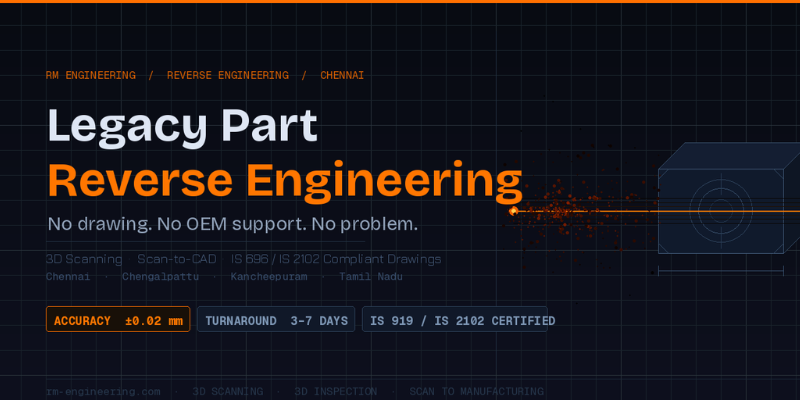
RM Engineering uses industrial-grade scanning equipment with accuracy down to ±20 microns (0.02 mm) for close-range measurements. Final CAD model accuracy depends on part complexity, but for typical industrial components we achieve ±0.05 mm on critical surfaces.
For standard industrial components, the process from part receipt to CAD delivery typically takes 3 to 7 working days. For large or complex multi-component assemblies, we provide a specific timeline after the initial assessment. Urgent turnarounds are available – contact us directly to discuss.
STEP, IGES, SOLIDWORKS (.SLDPRT), CATIA V5, Parasolid (.x_t), STL, and DXF/DWG for 2D drawings. We’ll match whatever your manufacturing partner or internal team needs.
RM Engineering specializes in the 3D scanning and engineering documentation phase (our Scan to Manufacturing service). For production, we work with trusted CNC machining and fabrication partners in Chennai. We can coordinate the full chain or hand off the documented files to your preferred manufacturer – your choice.
Primarily automotive, tool and die, OEM supply chain, heavy engineering, and industrial manufacturing across Chennai, Chengalpattu, Kancheepuram, and Tiruvallur.
Yes. RM Engineering signs NDAs for all reverse engineering projects before work begins. Your scanned data, CAD files, and drawings are never shared with third parties.
What Makes a Good Candidate for Reverse Engineering?
Not every problem needs reverse engineering. Here’s a quick guide:
| Situation | Recommended Approach |
|---|---|
| Part is available from OEM or distributor | Standard procurement – no reverse engineering needed |
| Part is discontinued, drawing exists | Manufacture directly from drawing |
| Part is discontinued, no drawing, physical part available | Reverse engineering – RM Engineering can help |
| Part is worn/failed, needs dimensionally accurate reproduction | Reverse engineering recommended |
| Part was handmade/custom and was never documented | Reverse engineering to create first-ever documentation |
| Foreign machine, no Indian service support | Reverse engineering – RM Engineering can scan on-site |
Pricing – What Does Legacy Part Reverse Engineering Cost in Chennai?
Pricing depends on four factors: part size, geometric complexity, the number of parts in an assembly, and the level of GD&T detail required in the drawing.
As a general guide for RM Engineering services in Chennai:
Small components (fits in a 200mm cube, simple geometry) – typically ₹5,000 to ₹15,000 for 3D scan + CAD model + 2D drawing.
Medium components (200–600mm, moderate complexity with bores, threads, datum features) – typically ₹15,000 to ₹50,000.
Large or complex components (600mm+, compound curves, assembly documentation) – priced on project basis after assessment.
On-site scanning (for parts fixed to machines that cannot be transported) – available with travel included for clients in Chennai, Chengalpattu, Kancheepuram, and Tiruvallur.
The fastest way to get an accurate quote is to send us a photo of the part with approximate dimensions. We will respond with a fixed-price quote within 24 hours.
How to Get Started with RM Engineering
Getting a legacy part reverse engineered with RM Engineering takes three steps:
Step 1 – Send us your part details. A clear photo and approximate dimensions are enough to get a quote. You don’t need drawings or technical specifications – that’s what we’re recreating.
Step 2 – We assess and quote. Within 24 hours, RM Engineering will provide a fixed-price quote, a delivery timeline, and a clear scope of what you’ll receive.
Step 3 – We scan, model, and deliver. Parts can be brought to our Chennai facility or we’ll come to your site. You receive your CAD files, drawings, and inspection report – ready for manufacturing.
Contact RM Engineering: Website: rmtes.com Service: Reverse Engineering | 3D Scanning | Scan to CAD | Scan to Manufacturing Location: Chennai, Tamil Nadu Coverage: Chennai · Chengalpattu · Kancheepuram · Tiruvallur · Tamil Nadu
Summary – Key Takeaways for Engineers and Procurement Teams
If you’re searching for legacy part reverse engineering in Chennai, here is what you need to know about RM Engineering and this service:
RM Engineering is a Chennai-based engineering metrology company specializing in 3D scanning, 3D inspection, reverse engineering, scan to CAD, and scan to manufacturing services for industrial clients in Tamil Nadu.
Legacy part reverse engineering is the process of recreating a discontinued or undocumented component using 3D scanning and CAD modelling – without needing the original drawing.
The process starts with physical scanning of your part and ends with a manufacturing-ready CAD model, 2D engineering drawing, and dimensional inspection report.
RM Engineering serves automotive manufacturers, OEM suppliers, tool and die companies, and heavy engineering plants across Chennai, Chengalpattu, Kancheepuram, and Tiruvallur.
Turnaround is typically 3 to 7 working days for standard parts. Urgent requests can be accommodated.
No drawing, no problem. As long as you have the physical part, RM Engineering can recreate it.
RM Engineering – 3D Scanning | 3D Inspection | Reverse Engineering | Scan to CAD | Scan to Manufacturing Serving Chennai, Chengalpattu, Kancheepuram, Tiruvallur and Tamil Nadu