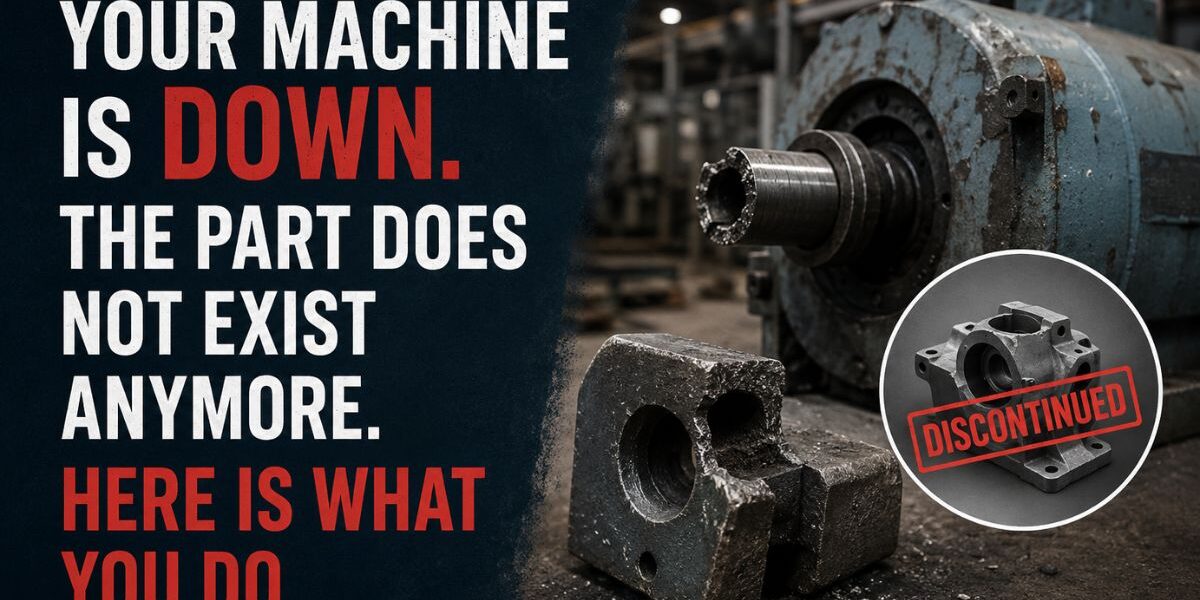
Let’s be honest about how this situation actually unfolds.
It is usually a Monday morning. Or worse, a Friday evening when you are heading into a weekend shift. A machine trips. Something breaks. The maintenance team pulls out the failed part and stares at it. Someone checks the ERP. No spare in stock. Someone else calls the OEM. Discontinued. Someone contacts three vendors. None of them have a drawing. By afternoon, you have a production line sitting idle and a plant head breathing down your neck.
This is not a rare situation. 8 out of 10 manufacturing companies have faced unplanned machine downtime in the last three years. And the number one reason is equipment failure, which causes nearly half of all production stoppages.
The cost is staggering. A large automotive plant in India can lose anywhere between 50 lakh to 1.5 crore rupees for every hour the line is stopped. That includes idle workers still on payroll, missed dispatch schedules, and penalty charges from OEM customers who expect parts on time, every time.
When you add it up, two days of a stopped line can cost more than an entire reverse engineering and part manufacturing job. The math almost always points to one decision: get the part scanned and made as fast as possible.
This is exactly the situation that emergency manufacturing using 3D scanning was built to solve.
At RM Engineering, we deal with this kind of call regularly. A plant manager in Sriperumbudur sends us a photo of a broken casting at 10 AM. By evening, we have scanned it, started the CAD reconstruction, and given them a confirmed timeline for the replacement part. That is what this blog is about.
What Is Emergency Manufacturing Using 3D Scanning?
Emergency manufacturing using 3D scanning is a fast-track process where you take a broken, worn, or discontinued physical part and use industrial 3D scanning to create the data needed to reproduce it, even when no drawing, no CAD file, and no OEM support exists.
The physical part becomes the blueprint.
Here is how it works in simple terms:
- The broken or surviving part is scanned using industrial-grade equipment
- The scan data is converted into a proper CAD model by engineers
- A manufacturing drawing is created
- The part is machined, cast, or fabricated from that drawing
- The finished part is inspected against the original scan before delivery
The whole chain, from scan to machined part, can happen in 5 to 10 working days for most industrial components. In genuine emergencies, simpler parts can move faster.
Why 3D Scanning Is the Fastest Route When You Have No Drawing
If your part still existed in a catalogue, you would just order it. You would not be reading this.
The problem is the drawing. Or rather, the absence of it.
Most production managers in India are dealing with equipment that is 15 to 30 years old. German presses, Japanese CNC machines, Korean injection moulding equipment. The OEM stopped supporting the Indian market a decade ago. The original drawings were never handed over. The vendor who made the tooling locally shut down. The engineer who knew the machine retired.
So when a part fails, your options without 3D scanning are:
- Try to measure the part manually with calipers and send rough dimensions to a machine shop. This leads to reproduction errors, especially on curved surfaces, compound angles, or precise bores.
- Wait for an imported spare that might take 8 to 16 weeks, if it is even available.
- Scrap the machine and buy a replacement.
3D scanning changes this completely. Instead of guessing at dimensions, a scanner captures the exact geometry of the part in 2 to 4 hours, millions of measurement points, accurate to ±0.02 mm. There is no interpretation, no approximation, and no room for a draughtsman’s mistake.
The scan becomes the drawing.
The Situations Where Plants Call RM Engineering
Here are the most common emergency scenarios we handle. You will probably recognise at least one.
“The part broke and there is no spare anywhere.”
A critical component fails during production. The OEM has discontinued it. Local distributors do not stock it. Your production scheduler is already calling.
This is the most common emergency call we get. As long as one surviving example of the part exists, whether it is the broken piece itself, an identical part from a sister machine, or a sample from another plant, we can scan it and start the reproduction process.
“We have no CAD drawing and the vendor wants one before quoting.”
You need to get a part made. You have a physical sample. But every machine shop you approach asks for a drawing or a 3D file. You do not have either.
We solve this. You send us the part, we scan it, build the CAD model, and produce a manufacturing drawing to IS 696 standard. Now any vendor can quote and manufacture from it.
“The import spare was discontinued. Lead time is 6 months.”
We hear this from heavy engineering plants regularly. A pump impeller, gearbox cover, or hydraulic manifold from a European machine has been discontinued. The importer gives you a 24-week lead time.
We scan the existing part, model it, and get it manufactured locally. For most standard industrial components, local CNC machining can deliver in 2 to 3 weeks from a good scan and drawing.
“The casting cracked and we cannot find a pattern anywhere.”
Cast parts present a unique challenge because you cannot just machine a replacement, you need a pattern first. And patterns rarely survive 20 years of use.
We scan the cracked casting, build a CAD model of it, and work with foundry partners to either produce a 3D-printed sand casting pattern or a direct cast reproduction, depending on quantity and urgency.
“Our tooling is worn and we need a new one made exactly like it.”
Tool room managers call us when a die, mould, or jig has worn beyond use and the original data no longer exists. We scan the worn tool, reconstruct the designed nominal geometry (not the worn geometry), and hand over production-ready data for re-manufacturing.
“We need to inspect a part before it goes into production.”
Purchase managers and quality teams call us when a batch arrives from a new vendor and they want to verify dimensions before using the parts. We scan a sample, compare it to the customer’s 3D model, and issue a deviation report. If everything is within tolerance, production proceeds. If not, we have evidence before a problem happens on the line.
How the RM Engineering Emergency Process Works
We do not ask you to fill out forms. We do not put you in a queue. Here is our actual process for emergency manufacturing requests.
Step 1: You send us a photo and basic details
A clear photo of the part and its approximate size is enough to start. You do not need a drawing. You do not need to measure anything. We will assess it and come back with a timeline and fixed quote within a few hours.
Step 2: We scan the part
You can bring the part to our Chennai facility or we come to your plant. For parts that are too large to move or fixed to a machine, we bring our scanning equipment on-site. The scan itself takes 1 to 4 hours depending on the size and complexity.
We use structured-light 3D scanning with accuracy down to ±0.02 mm. This meets the Fine tolerance class under IS 2102-1, which is the Bureau of Indian Standards specification for dimensional tolerances. For critical internal features like bores and threads, we add CMM measurements alongside the scan.
Step 3: We build the CAD model
This is where the engineering work happens. Our team does not just create a digital copy of the scan. They rebuild the part as a proper parametric solid model.
That means flat faces are made truly flat. Cylinders are made truly cylindrical. Threads are recognised and modelled to IS 4218 metric thread standards. Nominal geometry is reconstructed, not just as-found wear. This step typically takes 1 to 4 days depending on complexity.
Step 4: We produce a manufacturing drawing
Every job from RM Engineering includes a 2D engineering drawing produced to IS 696, which is the Bureau of Indian Standards code for engineering drawing practice. The drawing includes full dimensions, tolerances to IS 2102, surface finish to IS 3073, and GD&T callouts where the part requires it.
This drawing is yours. You can use it with RM Engineering’s manufacturing partners or take it to any vendor you prefer.
Step 5: Manufacturing
For clients who want the finished part, not just the drawing, RM Engineering coordinates CNC machining, fabrication, or casting with vetted manufacturing partners in Chennai, depending on the part type and material.
Step 6: First Article Inspection
Before the part is handed over, we scan it and compare it against the original CAD model. We produce a colour deviation map showing actual versus nominal dimensions across every surface. If it is within tolerance, it ships. If it is not, it goes back for correction before you receive it.
You get the part, the drawing, the CAD file, and the inspection report. All in one package.
What Kind of Parts Can RM Engineering Handle for Emergency Manufacturing?
Most industrial components are scannable. Here are the ones we handle most often:
Mechanical components Gears, shafts, bearing housings, flanges, couplings, pulleys, brackets, and covers. As long as you have a physical example, size and material are not obstacles.
Tooling and dies Mould inserts, die cavity blocks, press tool punches, jig plates, and fixture bodies. Even worn tooling can be scanned and reconstructed to the designed nominal geometry.
Cast components Pump housings, impellers, valve bodies, gearbox casings, and machine base castings. For casting reproduction, we work with foundry partners for pattern making and casting.
Imported machine components If your German, Japanese, or Korean machine has a discontinued part and the OEM no longer supports India, we can reverse engineer it from the physical part without any OEM cooperation or approvals.
Fabricated structures and weld assemblies Custom frames, brackets, and fabricated housings can be scanned to produce fabrication drawings and material cut lists.
Sheet metal components Body panels, enclosures, covers, and formed brackets.
The Real Cost of Waiting
Production managers instinctively want to explore every option before committing to an engineering service. That is reasonable. But there is a cost to that hesitation that rarely gets calculated.
The average manufacturing plant loses around 27 hours every single month to unplanned downtime. That is more than three full working days every month going to waste because of parts that failed and could not be replaced fast enough.
For a mid-sized supplier plant in Tamil Nadu, even a conservative estimate of 5 to 10 lakh rupees lost per day in stopped output means two days of downtime easily crosses what it would cost to get that part scanned, modelled, and manufactured by RM Engineering.
The math is not complicated. Getting the scan started is almost always the cheapest decision.
Why Plants Choose RM Engineering Over Individual Vendors
Most production managers deal with this kind of emergency by calling multiple vendors separately. A 3D scanning company for the scan. A CAD freelancer for the model. A machine shop for the part. A quality team for inspection.
That chain creates delays at every handoff. The scanning company sends data in a format the CAD person cannot open. The CAD model the freelancer builds has errors the machine shop does not catch until the part comes out wrong. The quality inspection happens after you have already installed the part.
RM Engineering handles the entire chain under one roof, one NDA, and one fixed price. We own the accuracy from scan to finished component. If the part does not match, it is our problem to fix.
That single point of accountability is what production managers and tool room heads tell us matters most when they are in an emergency.
Industries We Work With
Automotive and Tier 1 Suppliers in Chennai
The automotive corridor from Sriperumbudur through Oragadam and GST road is home to hundreds of component suppliers serving OEMs like Hyundai, TVS, Renault-Nissan, and Ashok Leyland. Tooling failures, press tool wear, and imported machine part discontinuation are weekly realities for these plants.
RM Engineering provides emergency scan-to-manufacture support with documentation that meets IATF 16949 quality system requirements. We can support First Article Inspection sign-off for your OEM customer.
Tool Rooms
Tool rooms in Ambattur, Guindy, and Chengalpattu call RM Engineering when a mould or die needs to be reproduced without original data. We rebuild the geometry, document it properly, and get the new tool made before the old one fails completely.
Heavy Engineering and Process Plants
Cement, steel, chemical, and power plants across Tamil Nadu regularly deal with obsolete equipment parts. We provide on-site scanning for parts that cannot be removed from the machine, along with the reverse engineering and manufacturing coordination to get replacements made.
OEM Suppliers and Contract Manufacturers
Suppliers who receive customer-owned tooling for production use RM Engineering’s inspection service to verify tool condition on receipt. If the tool deviates from the customer’s CAD model, we document it before a single production part is made.
Automation Integrators
Custom fixtures, end-of-arm tooling, and robot gripper components that are one-off designs and have no documentation can be scanned and documented by RM Engineering before or after deployment.
Frequently Asked Questions
How fast can RM Engineering complete an emergency scan job?
For a simple to medium-complexity part, scan and CAD delivery typically takes 2 to 5 working days. Finished machined components take 5 to 12 working days depending on material and machining complexity. For genuinely urgent situations, contact us directly and we will tell you what is possible for your specific part.
Can you scan a part that is broken or damaged?
Yes. We work with the best available physical reference, whether that is the broken part, a sister component from another machine, or an undamaged section. Our engineers reconstruct the designed geometry, not just a copy of the damage.
Do you come to our plant, or do we bring the part to you?
Both. Parts that can be safely transported can come to our Chennai facility. For large or fixed components, we bring our scanning equipment to your site. We cover Chennai, Chengalpattu, Kancheepuram, and Tiruvallur. Travel outside these districts is possible and is confirmed in your project quote.
What if the part has a reflective or shiny surface?
Shiny metal surfaces need a light scanning spray before the scan, which is a standard step in our process and is included in the project cost. It does not change the accuracy or the turnaround time.
Will you sign an NDA for our component design?
Yes. RM Engineering signs a Non-Disclosure Agreement before any scan data is collected. Your component geometry is confidential. We do not share scan data, CAD files, or drawings with any third party.
Can RM Engineering help if we need multiple pieces, not just one?
Yes. Once the CAD model is established from the scan, batch production can be coordinated. Per-unit costs drop significantly when quantities increase beyond the first prototype.
What file formats do we receive?
You receive a STEP or IGES file (compatible with SolidWorks, CATIA, AutoCAD, and most engineering software), a 2D DXF or DWG drawing to IS 696, and a dimensional inspection report with the colour deviation map. Native SolidWorks or CATIA files are available on request.
What You Get When You Work With RM Engineering
This is the complete package for every emergency manufacturing job:
- A manufacturing-ready 3D CAD model in your preferred format
- A 2D engineering drawing to IS 696 with full dimensions, IS 2102 tolerances, and surface finish callouts
- A deviation inspection report confirming the CAD model accuracy against the original part
- For Scan to Manufacture jobs: the finished machined component plus a First Article Inspection report
- A permanent digital record of your component that can support future repeat orders
You walk away with a solved problem and documentation that should have existed years ago.
Let Us Help You Get Back to Production
If your line is down or you can see a failure coming, the fastest thing you can do right now is send RM Engineering a photo of the part.
You do not need measurements. You do not need a drawing. You do not need to know the material. Just a clear photo and an approximate size is enough for us to assess the job and give you a confirmed timeline and fixed price, usually within a few hours.
RM Engineering specialises in 3D Scanning, 3D Inspection, Reverse Engineering, Scan to CAD, and Scan to Manufacturing for industrial manufacturers across Chennai and Tamil Nadu.
We serve production managers, plant heads, maintenance engineers, tool room managers, OEM suppliers, automotive component manufacturers, and automation integrators who need parts made fast, made accurately, and made with proper documentation.
Visit us at rmtes.com or call us directly for emergency requests.
Location: Chennai, Tamil Nadu Coverage: Chennai, Chengalpattu, Kancheepuram, Tiruvallur and across Tamil Nadu
Related Blogs:
3D Scanning Services Cost in India — Full Price Guide (2026)