Most production managers and purchase managers spend a lot of time comparing prices when they need a reverse engineering service. Price matters, of course. But price is the last thing you should be looking at.
The right question is not “who is cheapest?” It is “who will actually get this right?”
A wrong CAD model costs you more than the scan ever did. A machined part that does not fit means rework, delays, and another round of production downtime. A vendor who cannot explain their process clearly is a vendor who will struggle to deliver what you actually need.
This guide gives you every question worth asking before you hand your part to a reverse engineering company. Use it whether you are calling vendors in Chennai, across Tamil Nadu, or anywhere in India.
Why This Decision Matters More Than You Think
Reverse engineering is not a commodity service. Two vendors can both say they do “3D scanning and CAD modelling” and deliver results that are worlds apart.
One delivers a mesh file that no CNC shop can use. The other delivers a fully parametric solid model with a proper manufacturing drawing that any vendor can work from immediately.
One vendor scans the worn surface of your part and copies the wear into the CAD model. The other understands that you need the designed nominal geometry, not a digital copy of the damage.
The difference between these two outcomes is the set of questions you ask before you place the order.
The Questions You Must Ask Before Hiring
1. Do You Do Scan-to-CAD Reconstruction, or Do You Just Deliver a Mesh?
This is the most important question on this entire list. Ask it first.
A 3D scan produces raw data called a mesh or STL file. This is a surface made up of millions of tiny triangles. It looks like a 3D model but it is not an engineering model. You cannot directly use it for CNC machining, and most CAD software cannot edit it.
What you actually need is a parametric CAD solid model. This is a proper engineering file where every feature, every hole, every surface is defined and editable.
The difference between these two is the scan-to-CAD reconstruction step. Many vendors in India skip this or outsource it to a freelancer with no engineering background.
Ask directly: “Do your own engineers rebuild the parametric CAD model, or do you deliver the mesh and let someone else handle it?”
The right answer is that qualified engineers do the CAD reconstruction in-house, with a defined process and a quality check at the end.
2. What Is Your Scanning Accuracy, and Is It Right for My Part?
Accuracy is not one number. It depends on the equipment, the part size, and the scanning method used.
Ask the vendor to tell you their scanning accuracy in millimetres, not in vague terms like “high precision” or “industry leading.”
For most industrial components in manufacturing and automotive supply, you need scanning accuracy of ±0.02 mm to ±0.05 mm. This covers the Fine and Medium tolerance classes under IS 2102-1, which is the Bureau of Indian Standards specification for dimensional tolerances.
If a vendor cannot tell you their accuracy in numbers, move on.
Also ask: does their accuracy claim match the equipment they are using? A structured light scanner and a FARO arm laser tracker have very different accuracy profiles for different part sizes. A good vendor will explain which method suits your specific part and why.
3. Do You Reconstruct Design Intent or Just Copy the As-Found Geometry?
This question separates engineers from technicians.
When a part has been in service for years, it will have wear, minor deformations, and surface scuffing. If a vendor simply copies the scanned geometry into the CAD model, those imperfections will be reproduced in the new part. The replacement will fit as badly as the worn original did.
What you need is design intent reconstruction. This means the CAD engineer looks at the scanned data and rebuilds what the part was supposed to be, not what wear has made it into. Flat faces are made truly flat. Cylinders are made truly cylindrical. Standard features like threads and chamfers are reconstructed to their correct nominal dimensions.
Ask directly: “If my part is worn or damaged, how do you handle that in the CAD reconstruction?”
A vendor who says “we model exactly what we scan” is telling you something important. They are not doing engineering. They are doing data processing.
4. What Deliverables Do I Get, Exactly?
Before you pay anything, get a written list of exactly what you will receive when the job is done.
Here is what a complete reverse engineering deliverable looks like:
- A parametric 3D CAD solid model in your preferred format (STEP, IGES, SolidWorks .SLDPRT, CATIA V5)
- A 2D manufacturing drawing with full dimensions, tolerances, surface finish callouts, and GD&T where required
- A deviation inspection report showing the accuracy of the CAD model against the original scan
- The point cloud or mesh data if you want it for your own records
In India, engineering drawings should follow IS 696, which is the Bureau of Indian Standards code for engineering drawing practice. Tolerances should follow IS 2102. Surface finish should be called out per IS 3073. If a vendor does not know these standards, their drawings will not be usable with Indian machine shops and vendors without rework.
Ask: “Can you show me a sample drawing from a previous job?” A good vendor will have no hesitation showing you their drawing standard and format.
5. Will You Sign an NDA Before You Start?
This question gets skipped surprisingly often, and it should not be.
When you hand a physical part to a reverse engineering company, you are giving them the geometry of your component. For proprietary designs, custom tooling, or parts you manufacture for OEM customers, that geometry is confidential.
A professional reverse engineering company will sign a Non-Disclosure Agreement before any scan data is collected. If a vendor pushes back on this or says it is unnecessary, that is a red flag.
Also ask: after the project is complete, what happens to your scan data and CAD files? Are they stored on their servers indefinitely? Are they shared with manufacturing partners or subcontractors? Get clarity on this before the project starts, not after.
6. Can You Handle On-Site Scanning or Is Everything Done in a Lab?
Some parts cannot be transported. A large machine base, a press tool bolted to the floor, a pump impeller inside a live plant that cannot be fully disassembled. For these situations, the scanning engineer needs to come to your facility.
Not all vendors have this capability. Many operate as lab-only services that require you to courier the part to them.
Ask directly: “Do you offer on-site scanning? And does that add to the cost or is it included in the project quote?”
For manufacturers in Chennai and Tamil Nadu, also ask which districts they cover. Chennai, Chengalpattu, Kancheepuram, Tiruvallur, and other industrial areas around the city should all be within a good vendor’s regular service range.
7. How Do You Verify the CAD Model Accuracy Before Handing Over?
This question is one that most buyers never think to ask. And most vendors are hoping they will not.
After the CAD model is built, it should be validated against the original scan data. This is done using inspection software that compares the CAD solid model point by point against the original point cloud, producing a colour deviation map that shows where the model matches the part and where it deviates.
Without this step, you are trusting the CAD engineer to have gotten it right. With it, you have documented proof of the model accuracy before you use it to make anything.
Ask: “Do you provide a deviation inspection report comparing the finished CAD model to the original scan?”
If the answer is no, ask why. If the answer is “that is an extra charge,” factor that into your evaluation. It should not be optional.
8. What File Formats Do You Deliver, and Are They Compatible With My Software?
This sounds like a simple question but it catches many buyers off guard after the project is done.
The most commonly needed formats for manufacturing in India are:
- STEP (.stp or .step) for universal CAD compatibility
- IGES (.igs) for surface data exchange
- SolidWorks (.SLDPRT) for teams using SolidWorks
- CATIA V5 (.CATPart) for OEM supplier teams
- DXF or DWG for 2D drawings compatible with AutoCAD
Ask your vendor early: “What formats do you deliver as standard, and what formats are available on request?” If your machine shop or OEM customer requires a specific format, confirm the vendor can provide it before the project starts.
9. What Is Your Turnaround Time, and What Happens If You Miss It?
Turnaround matters a lot when a machine is stopped or a production deadline is approaching.
Most Indian reverse engineering providers give estimates but not commitments. Push for clarity. Ask for a specific number of working days from part receipt to final file delivery.
Realistic turnaround times for in-lab scanning in India:
- Small to medium parts with scan and CAD model: 3 to 7 working days
- Complex parts with full drawing and inspection report: 7 to 14 working days
- On-site scanning projects: depends on travel and part complexity
Also ask what happens if they miss the timeline. A serious vendor will have a clear answer. A vendor who gets vague at this question is giving you important information about how they handle commitments.
10. Have You Done Similar Parts Before?
Industry experience is not glamorous but it matters enormously in reverse engineering.
An automotive casting with complex curved surfaces, internal galleries, and critical bore locations is a very different job from a flat bracket with a few holes. A vendor who has only handled small consumer product scans will struggle with the engineering judgement required for a heavy engineering gearbox housing.
Ask for examples from your specific industry. A good vendor will be able to describe two or three past projects that are similar to yours, explain the challenges they faced, and tell you how they handled them.
If they only show you before-and-after photos with no technical detail, ask follow-up questions: What was the accuracy? What drawing standard did you use? Did the client manufacture from your files without modification?
11. Do You Handle the Full Chain or Just the Scanning?
This question is particularly important if you also need the part manufactured and not just documented.
Many vendors in India do scanning only. Some do scanning and CAD. Very few do the full chain from scan through CAD through manufacturing coordination and First Article Inspection.
If you need a finished machined part, not just a CAD file, ask whether the vendor manages that or whether you need to find a separate machine shop and hand over the files yourself.
Managing the chain yourself means managing handoffs, format compatibility between vendors, and responsibility gaps when something goes wrong. A single vendor who manages the full process from scan to finished part removes all of those risks.
12. What Is Included in the Price and What Is Extra?
Get this in writing before you start.
Common extra charges that surprise buyers:
- NDA signing (some vendors charge for this, which is unusual but happens)
- Urgent or express turnaround premium (30 to 50 percent above standard rate)
- On-site travel costs beyond the vendor’s local area
- CAD file in native format vs standard STEP (some vendors charge for native formats)
- Deviation inspection report (sometimes positioned as an add-on)
- 2D drawing production (sometimes quoted separately from the CAD model)
A trustworthy vendor gives you a fixed-price quote that includes all of these, or is completely transparent about what is and is not included. Ask for a line-by-line breakdown if the quote is a single number.
The Red Flags That Should Make You Walk Away
Even if a vendor answers all the above questions, some answers should stop you immediately.
They cannot tell you their scanning accuracy in numbers. Any professional setup knows their equipment specifications. Vague language around accuracy means either the equipment is inadequate or the operator does not understand it.
They deliver only mesh or STL files and call it “3D modelling.” An STL file is not a CAD model. A vendor who does not know this difference should not be trusted with precision engineering work.
They say “design intent is the same as as-built.” It is not. These are different engineering decisions with different outputs. A vendor who cannot explain this distinction does not understand the engineering side of what they are doing.
They cannot show you a sample drawing. A professional reverse engineering service has sample outputs they can share. If they refuse or cannot produce one, ask yourself why.
They will not sign an NDA. No serious engineering company operating in manufacturing supply chains refuses to sign a standard NDA.
They are not available for a technical discussion before the quote. If a vendor will only communicate via WhatsApp messages and cannot put you in touch with the engineer who will do the work, that tells you something about how your project will be managed.
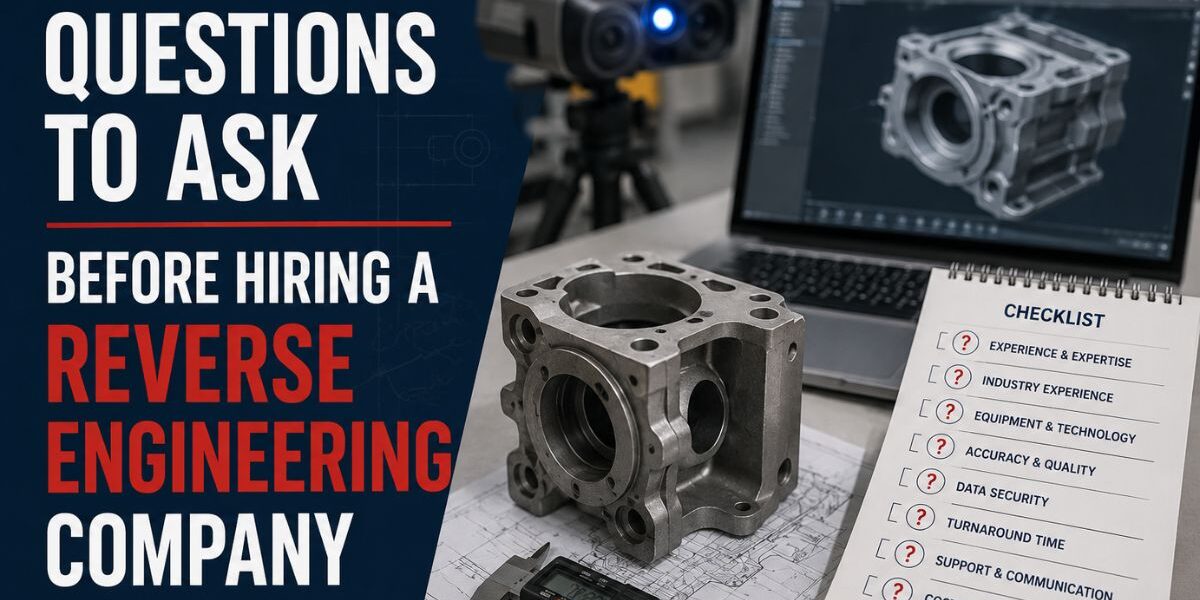
A Quick Checklist to Use Right Now
Print this or screenshot it for your next vendor evaluation call.
- Can you tell me your scanning accuracy in millimetres?
- Do your own engineers do the parametric CAD reconstruction in-house?
- How do you handle worn or damaged geometry in the CAD model?
- What exactly do I receive as deliverables? Is a 2D drawing included?
- Do your drawings follow IS 696 standard?
- Will you sign an NDA before work starts?
- Do you offer on-site scanning for large or fixed components?
- Do you provide a deviation inspection report validating the CAD model?
- What file formats do you deliver?
- What is your turnaround in working days, with a commitment?
- Can you show me samples from similar past projects?
- Do you handle manufacturing coordination, or scanning only?
- What is included in the quoted price and what is extra?
Any vendor you are seriously considering should be able to answer every question on this list clearly and without hesitation.
Why Buyers Choose RM Engineering for Reverse Engineering in Chennai
At RM Engineering, we have built our service around every question on this list.
We do scan-to-CAD reconstruction with qualified in-house engineers. We do not outsource the modelling or hand over mesh files and call it done. We deliver parametric solid models, IS 696-compliant 2D drawings, and deviation inspection reports as a standard part of every job.
We use industrial structured-light 3D scanning equipment with accuracy down to ±0.02 mm. We sign NDAs before any scan begins. We offer on-site scanning across Chennai, Chengalpattu, Kancheepuram, and Tiruvallur. We handle the full chain from scan to manufactured component for clients who need a finished part, not just a file.
When you call RM Engineering with a part, you will speak to an engineer who can explain every step of what we do and why. You will get a fixed-price quote within 24 hours of sending us a photo of the part. You will know exactly what you are receiving before the project starts.
That is what a professional reverse engineering company looks like.
If you are evaluating reverse engineering services in Chennai or Tamil Nadu, contact RM Engineering at rmtes.com. Send us a photo of your part and we will tell you how we would approach it, what it will cost, and when you will have it back.
No pressure. Just straight answers, which is exactly what you should expect from every vendor you are considering.