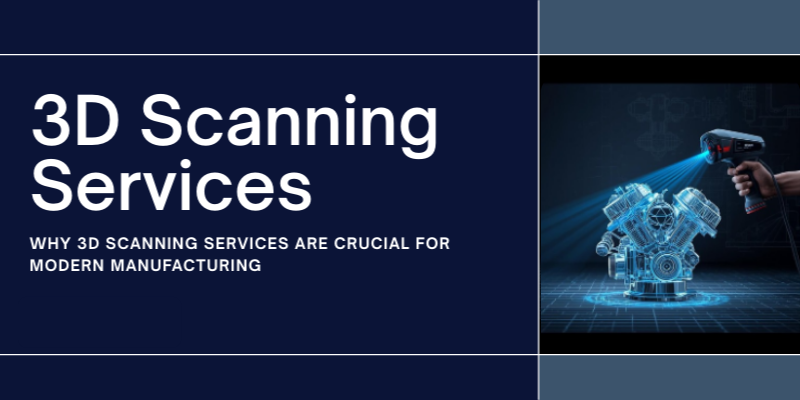
Modern manufacturing operates in an environment defined by tight tolerances, shorter product lifecycles, and digital integration requirements. Traditional measurement systems are no longer sufficient for complex geometries, freeform surfaces, and large-scale assemblies.
3D scanning services provide high-accuracy, non-contact, full-surface measurement that converts physical components into complete digital models. This capability improves quality control, accelerates product development, and reduces operational risk across multiple industries.
Market Growth: “The global 3D scanning market is projected to expand from USD 4.28 B by 2030, highlighting rapid industrial adoption
What Is 3D Scanning in Manufacturing?
3D scanning is a digital metrology process that captures the physical geometry of an object using laser or structured light technology.
The system projects light onto the part and records distortions with sensors. Software processes this information into:
- Point clouds
- Polygon mesh models
- Parametric CAD geometry
- Color deviation inspection reports
Unlike traditional tools that measure selected dimensions, 3D scanning captures entire surfaces. This enables complete geometric validation rather than partial inspection.
Why Traditional Measurement Methods Fall Short
Manufacturing complexity has increased due to:
- Multi-axis machining
- Lightweight material usage
- Advanced composites
- Freeform product design
Manual tools and even coordinate measuring machines (CMMs) measure discrete points sequentially. This can miss subtle surface deviations.
3D scanning captures millions of data points per second. It provides comprehensive coverage and reduces inspection programming time.
For complex parts, this results in:
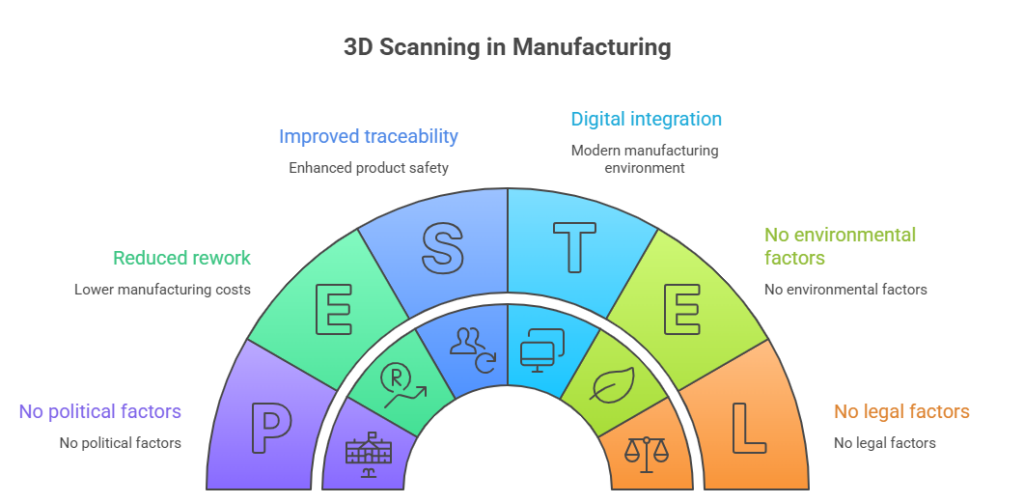
- Faster first article inspection
- Better detection of distortion
- Reduced rework
- Improved traceability
Core Benefits of 3D Scanning Services
High Accuracy and Repeatability
Industrial 3D scanners typically operate within ±0.02 mm to ±0.05 mm accuracy.
This level of precision supports:
- Automotive tolerance validation
- Aerospace compliance
- Medical device inspection
- Tooling verification
Repeatable data ensures consistency across inspection cycles.
Full-Surface Deviation Analysis
Scanning generates complete color maps comparing actual geometry to nominal CAD.
This reveals:
- Warpage
- Springback
- Shrinkage
- Tool wear patterns
- Assembly misalignment
Full-field analysis reduces the risk of undetected dimensional errors.
Non-Contact Measurement
Non-contact systems eliminate:
- Surface damage
- Probe-induced deformation
- Measurement inconsistencies
This is particularly important for thin-wall parts, polished components, and delicate assemblies.
Reverse Engineering Capability
When CAD files are unavailable or outdated, scanning enables accurate digital reconstruction.
Applications include:
- Obsolete spare part reproduction
- Mold duplication
- Legacy equipment modernization
- Aftermarket component design
Reverse engineering ensures production continuity.
Industry Applications of 3D Scanning
Automotive Manufacturing
Automotive production requires dimensional consistency at scale.
Applications include:
- Body panel inspection
- Gap and flush measurement
- Casting validation
- Fixture alignment
- Prototype digitization
Full-surface scanning detects distortion and tool wear before large production batches are affected.
Aerospace Manufacturing
Aerospace components require traceable dimensional compliance.
Common applications:
- Turbine blade geometry verification
- Composite panel contour validation
- Landing gear inspection
- Jig and fixture certification
3D scanning supports stringent inspection documentation and quality assurance workflows.
Medical Device Manufacturing
Medical manufacturing demands precision and repeatability.
Applications:
- Orthopedic implant inspection
- Custom prosthetic modeling
- Surgical instrument validation
- Sterile packaging mold verification
Non-contact scanning protects sensitive surfaces while maintaining measurement integrity.
Oil, Gas & Energy
Industrial facilities often operate with outdated drawings.
3D scanning supports:
- As-built documentation
- Piping alignment analysis
- Deformation monitoring
- Retrofit planning
Digital models reduce clash risk during plant modifications.
Heavy Machinery & Industrial Equipment
Large assemblies are difficult to measure with traditional tools.
Scanning supports:
- Weldment flatness checks
- Gear profile analysis
- Casting validation
- Machine calibration
Portable systems eliminate the need for transportation of heavy equipment.
Consumer Electronics & Precision Manufacturing
Miniaturized components require high dimensional accuracy.
Applications include:
- Plastic housing inspection
- Die-cast enclosure validation
- Connector alignment verification
- Thermal simulation preparation
Full-field inspection improves product fit and cosmetic quality.
Tool & Die / Mold Manufacturing
Tooling precision directly impacts production quality.
3D scanning is used for:
- Mold cavity validation
- Tool wear monitoring
- Electrode inspection
- Reverse engineering successful tools
Early wear detection prevents large-scale defects.
What Makes RM Engineering Stand Out in 3D Scanning Services
In a market with multiple service providers, differentiation comes from technical depth, workflow integration, and operational flexibility.
Advanced Industrial-Grade Equipment
RM Engineering utilizes high-resolution laser and optical scanning systems capable of capturing complex geometries with micron-level precision. Their equipment portfolio supports:
- Small precision components
- Large industrial assemblies
- Freeform and reflective surfaces
This versatility allows seamless handling of varied manufacturing environments.
Complete Scan-to-CAD Workflow
The company delivers more than raw scan data.
Services include:
- Point cloud processing
- Mesh optimization
- Parametric CAD modeling
- CAD-to-part comparison
- GD&T-based inspection reports
Manufacturers receive engineering-ready deliverables compatible with major CAD platforms.
On-Site Scanning Capability
Portable systems allow scanning directly at client facilities.
Benefits include:
- Reduced downtime
- No transportation risk
- Faster project turnaround
- Immediate engineering feedback
Large weldments, production fixtures, and assembled machinery can be scanned in place.
Industry-Aligned Expertise
RM Engineering aligns its workflow with real manufacturing requirements.
Experience spans:
- Automotive validation
- Aerospace inspection support
- Medical device documentation
- Industrial plant digitization
- Tool and mold verification
This ensures inspection reports are structured for practical engineering decision-making.
Confidentiality and Data Security
Engineering data is handled under strict confidentiality protocols.
Options include:
- NDA agreements
- Secure digital delivery
- Controlled data storage
Sensitive design information remains protected.
Fast Turnaround and Responsive Support
Standard projects are processed within short timelines, with structured reporting formats ready for engineering integration.
Post-delivery technical support ensures clients can effectively use scan data within their design and quality systems.
When Should Manufacturers Use 3D Scanning?
3D scanning is ideal when:
- Parts feature complex freeform geometry
- First article inspection requires complete validation
- Dimensional drift is suspected
- CAD files are missing
- Large assemblies cannot be moved easily
- Compliance documentation is required
It complements, and in many cases enhances, traditional inspection workflows.
Frequently Asked Questions
How accurate is industrial 3D scanning?
Most industrial scanners operate within ±0.02–0.05 mm accuracy, depending on part size and environment.
Can reflective or dark parts be scanned?
Yes. Advanced systems handle challenging surfaces. Temporary removable coatings may be used for mirror-finish components.
How long does a project take?
Small components typically require 24–48 hours. Larger assemblies may require 48–72 hours. Reverse engineering projects vary based on complexity.
What file formats are delivered?
Common formats include:
- STL
- STEP
- IGES
- Parasolid
- Native CAD files
- PDF inspection reports
Compatibility with major CAD systems is standard.
Is 3D scanning cost-effective?
For complex geometries and full-field analysis, 3D scanning often reduces inspection time and prevents costly production errors, delivering strong return on investment.
Conclusion
3D scanning services have become foundational to precision manufacturing. They provide comprehensive geometric visibility, accelerate inspection cycles, and support digital transformation across automotive, aerospace, medical, energy, heavy machinery, electronics, and tooling industries.
As production tolerances tighten and product complexity increases, full-surface digital measurement is no longer optional. Manufacturers integrating advanced scanning workflows gain measurable improvements in quality, efficiency, and traceability.
For organizations seeking high-accuracy, industry-aligned 3D scanning solutions with complete scan-to-CAD capability and on-site expertise, RM Engineering delivers precision-driven services tailored to modern manufacturing environments.