The Problem Every Chennai Manufacturer Knows Too Well
A critical machine on your production floor has stopped. The part that failed is 20 years old: imported, discontinued, and the original supplier no longer exists. Your maintenance team searches through old files, calls vendors, checks with OEM contacts. Nothing.
No drawings. No CAD files. No spare in stock.
Every hour the line is down, you’re losing money.
This is not a rare situation. Across Chennai’s manufacturing clusters: from the auto component units in Ambattur and Sriperumbudur, to the pump and valve manufacturers in Coimbatore Road, to the precision engineering firms in Guindy and Ekkatuthangal: obsolete spare parts are one of the most common and costly production problems.
The good news: you don’t need the original drawings anymore. Modern reverse engineering technology can reproduce any physical part with high accuracy: even if all you have is the broken piece in your hand.
This guide walks you through exactly how it works.
Why Traditional Methods No Longer Work
Before we get to the solution, let’s understand why the old approaches fail.
Manual measurement: using vernier calipers, micrometers, and templates: works for simple flat components. But for parts with complex curves, internal channels, freeform surfaces, or tight tolerances, manual measurement introduces errors that compound during machining. You end up with a part that looks right but doesn’t fit or perform correctly.
Contacting the OEM: often impossible for parts discontinued more than a decade ago. Many original manufacturers no longer support older models, have closed down, or won’t share IP even if they could help.
Finding a third-party vendor: without drawings or a digital file, most machining shops won’t take the job. Those that do rely on manual measurement, which brings you back to the first problem.
The missing link in all these approaches is the same: no accurate digital model of the part.
That’s exactly what 3D scanning and reverse engineering provides.
The Modern Solution: Scan → Engineer → Manufacture
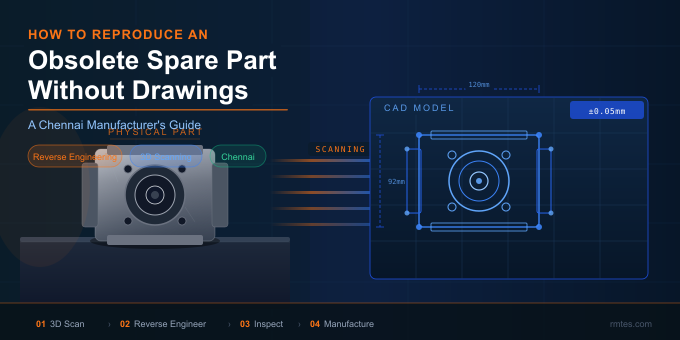
Here is the complete process that R M Engineering Technologies uses to reproduce a physical part from scratch: no drawings required.
Step 1: 3D Scanning the Physical Part
The process begins with a high-resolution 3D scan of your existing part: even if it’s worn, damaged, or broken.
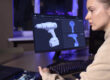
Using professional-grade 3D scanners, every surface of the part is captured as a dense cloud of data points (called a point cloud). This scan records the exact geometry of the object: every curve, hole, thread, chamfer, and surface finish: typically to an accuracy of ±0.05 mm or better.
What you can bring us:
- A worn or partially damaged part (we can account for wear and reconstruct the original geometry)
- A broken part (even fragments can be scanned and reconstructed)
- An imported part with no documentation
- A pattern or mould you want to replicate
The scan takes anywhere from a few hours to a day depending on part complexity and size. You don’t need to dismantle your machine permanently: in many cases, we can scan on-site at your facility.
Step 2: Reverse Engineering: From Point Cloud to CAD Model
Raw scan data is a point cloud, not a usable engineering file. The reverse engineering step converts it into a precise parametric CAD model: the same kind of file a product designer would create from scratch.
Our CAD engineers work from the scan data to:
- Reconstruct all geometric features (bosses, bores, threads, keyways, radii)
- Apply design intent: for example, recognising that a surface should be perfectly flat at 90°, even if the worn part is slightly off
- Add manufacturing tolerances and fits appropriate to the function of the part
- Output the model in any standard format: STEP, IGES, SolidWorks, AutoCAD, and others
This is where expertise matters most. Converting a scan into a manufacturable drawing requires engineering judgment: not just software. Our team has handled everything from transducer moulds for NIOT Chennai to precision jigs for automotive suppliers.
The output of this step is a complete 2D engineering drawing and 3D CAD model, ready for manufacturing.
Step 3: 3D Inspection: Verifying Before You Machine
Before committing to full production, we perform a 3D inspection that compares the digital model back against the original scanned part.
This catches any discrepancies between the physical part and the digital reconstruction: ensuring the drawing we hand over to the machinist is accurate and complete.
For critical components (high-pressure, high-speed, or safety-critical parts), this step is non-negotiable. It’s the quality checkpoint that separates professional reverse engineering from guesswork.
Step 4: Manufacturing the Part
With a verified CAD file and engineering drawing in hand, manufacturing can begin.
R M Engineering Technologies operates CNC machining, conventional turning, and milling capabilities in-house. This is the critical advantage of working with us over a scanning-only vendor: you don’t have to hand a drawing to a third-party machinist and hope for the best. We control the full chain.
We manufacture:
- Single prototype parts for validation
- Small batch replacements for critical spares
- Series production once the part is proven
Materials we regularly work with include: mild steel, stainless steel, aluminium alloys, bronze, brass, and engineering plastics.
What Types of Parts Can Be Reproduced This Way?
Almost any mechanical component. Here are the most common categories we handle for Chennai manufacturers:
| Part Type | Typical Use Case |
| Pump impellers & casings | Obsolete imported pumps, worn castings |
| Gear sets & sprockets | Legacy gearboxes, discontinued models |
| Jigs, fixtures & gauges | No original drawing, worn-out tooling |
| Housing & brackets | Structural parts with complex geometry |
| Moulds & dies | Damaged tooling that needs replication |
| Valve bodies & seats | High-pressure fluid handling systems |
| Coupling & adaptor flanges | Non-standard interfaces |
| Transducer & sensor housings | Scientific and defence applications |
If you’re unsure whether your part can be reproduced, send us a photo on WhatsApp. We’ll tell you within a few hours.
How Long Does It Take?
This is usually the first question after “can you do it?”
Here is a realistic timeline for a typical spare part reproduction project:
| Stage | Typical Duration |
| 3D Scanning | 4–8 hours (or 1 day for large/complex parts) |
| Reverse Engineering (CAD) | 1–3 days |
| 3D Inspection & Verification | 4–8 hours |
| CNC Machining | 2–5 days (depends on material and complexity) |
| Total (typical) | 5–10 working days |
For urgent breakdowns, contact us directly: we prioritise critical production stoppage cases.
Why This Matters Specifically for Chennai Manufacturers
Chennai is one of India’s most important manufacturing hubs. The city hosts:
- Over 400 auto component manufacturers supplying OEMs like Hyundai, Ford, Renault-Nissan, and Ashok Leyland
- A large concentration of pump, valve, and fluid handling manufacturers
- Significant defence and aerospace supply chain companies
- Thousands of precision engineering MSMEs
Many of these businesses operate machines that are 10, 20, or even 30 years old: German, Japanese, Italian, and Korean equipment that is no longer supported by its original manufacturer. When a critical part fails on one of these machines, the choice is usually between importing a replacement (expensive, slow, sometimes impossible) or finding a local solution.
Reverse engineering and local manufacture is that solution. It reduces dependency on imports, keeps the cost in Chennai, and often delivers a part that is as good as: or better than: the original.
It also supports the Make in India and Atmanirbhar Bharat vision in a very practical, ground-level way: every imported part that can be locally reproduced is one less foreign exchange outflow and one more Chennai job.
Common Questions from Manufacturers
Do I need to provide drawings or any documentation? No. All we need is the physical part. If you have partial documentation (old purchase orders, assembly manuals with rough dimensions), that’s helpful but not required.
What if my part is badly worn or damaged? Worn and damaged parts are handled routinely. Our engineers reconstruct the original design intent from what remains. For parts broken into multiple pieces, we can scan each piece and digitally reassemble them.
Can you come to our factory to scan? Yes. For large equipment, machines that cannot be disassembled, or parts that are too large to transport, we offer on-site scanning at your facility anywhere in Chennai and the surrounding region.
Is our part design kept confidential? Completely. We do not share, reproduce, or retain client part designs without written permission. A standard NDA is available on request.
What if we want to improve the part, not just copy it? That’s reverse engineering’s real power. Once we have the CAD model, modifications, tolerance improvements, material upgrades, and design changes can all be incorporated before manufacturing. Many clients use this as an opportunity to improve on the original.
What’s the minimum order quantity? One. We regularly produce single prototype parts for validation before committing to batch production.
Getting Started: What to Do Next
If you have an obsolete part that needs reproducing, the fastest path forward is simple:
Step 1: Take a clear photo of the part (all angles if possible).
Step 2: WhatsApp it to us at +91 98408 62525 with a brief description of what it is and what machine it belongs to.
Step 3: We’ll respond within 2 hours with an initial assessment and next steps.
Alternatively, bring the part directly to our facility:
RM Engineering Technologies No. 20, Gandhi Nagar Main Road, Ekkatuthangal, Chennai – 600 032
Or email us at in**@***es.com
Summary
You don’t need original drawings to reproduce a spare part. With 3D scanning and reverse engineering, any physical component can be accurately digitised, converted into a full CAD model, inspected for accuracy, and manufactured: in Chennai, in days, not months.
The process is proven, the technology is accurate, and the turnaround is fast enough to get your production line moving again.
RM Engineering Technologies provides the complete chain: from scan to manufactured part: under one roof in Chennai.